Skip to content
Industrial UWB RTLS for Real-Time Visibility
Menu

Tunnel Personnel Real-Time Location System (UWB RTLS)

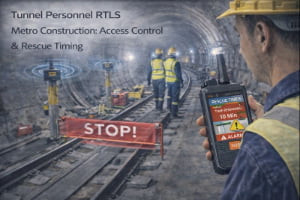
Tunnel and underground projects are some of the most challenging environments for safety management. Crews work in long, narrow headings with poor visibility, heavy equipment, and changing ventilation conditions. Supervisors need to know who is in the tunnel, where they are, and whether they are moving normally at any point in time – especially when blasting, lining, or night‑shift operations are in progress.

This solution uses UWB centimeter‑level positioning combined with dual‑channel tunnel anchors, wireless UWB beacons, and worker wearables mounted on helmets or safety vests. The system builds a one‑dimensional corridor model along the tunnel alignment, with optional 2D positioning in caverns, cross passages, and adits. Location data is sent over wired or 4G backhaul to the GridRTLS platform, which provides real‑time tracking, e‑fence alarms, gas‑safety linkage, and emergency mustering for every person underground.

Solution Details

Category
People RTLS & Safety
Industries
Construction Transportation & Rail Tunnel & Underground
Environments
Tunnel Yard Underground
Implementation
complex

Overview

Tunnel and underground projects are some of the most challenging environments for safety management. Crews work in long, narrow headings with poor visibility, heavy equipment, and changing ventilation conditions. Supervisors need to know who is in the tunnel, where they are, and whether they are moving normally at any point in time – especially when blasting, lining, or night‑shift operations are in progress.

This solution uses UWB centimeter‑level positioning combined with dual‑channel tunnel anchors, wireless UWB beacons, and worker wearables mounted on helmets or safety vests. The system builds a one‑dimensional corridor model along the tunnel alignment, with optional 2D positioning in caverns, cross passages, and adits. Location data is sent over wired or 4G backhaul to the GridRTLS platform, which provides real‑time tracking, e‑fence alarms, gas‑safety linkage, and emergency mustering for every person underground.

The Tunnel Personnel RTLS solution is suitable for railway and highway tunnels, metro extensions, utility and water conveyance tunnels, and cross‑harbor / river‑crossing projects. It reuses the same tag family and RTLS engine as factory deployments, so contractors can share badges and helmets across surface yards, shafts, and underground headings while keeping all movement history in one system.
Pain Points

No real‑time visibility of crews inside the tunnel

Once workers enter the tunnel, supervisors often rely on radio check‑ins or manual head‑counts to know who is underground. These methods quickly break down in multi‑kilometer tunnels with several headings, cross passages, and subcontractor teams. Without continuous positioning, it is difficult to answer basic questions such as “who is still inside?” or “where are they right now?” during normal operations or emergencies.

Slow emergency search and rescue

In the event of rockfall, gas leak, fire, or equipment failure, control rooms typically only know the approximate area where crews are assigned. Valuable minutes are lost trying to reach workers by phone or radio and asking for their position. Lack of precise last‑seen locations increases evacuation time and puts both workers and rescue teams at higher risk.

Mixed people–vehicle operations in narrow headings

Tunnels concentrate heavy machinery – roadheaders, spray rigs, mucking trucks, locomotives – in confined spaces. When visibility is low and radio channels are busy, it is hard to keep people away from moving equipment or to understand how many people are working near an active heading, cross passage, or shaft bottom.

Incomplete records for regulators and owners

Many projects still depend on paper sign‑in sheets or shift logs to prove who was in the tunnel and for how long. These records are hard to reconcile across contractors and are rarely detailed enough to support incident investigations, safety audits, or performance optimization.

System Architectures & Topology

Wired UWB Tunnel RTLS (Dual‑Channel Anchors)

Architecture ID: tunnel_wired_std

Tunnel Underground Metro / Subway Projects Railway Construction
  • Dual‑channel STD tunnel anchors and SW UWB anchors are installed on tunnel side walls every 100–300 m, powered by PoE or DC. Tags on helmets and wristbands exchange UWB ranging signals with at least two anchors at all times. Anchor data is carried via industrial switches and fiber or copper to an on‑premise RTLS server in the control room. The positioning engine runs a one‑dimensional corridor model along the tunnel chainage, with optional 2D positioning in caverns, stations, and chambers. The GridRTLS platform displays live worker positions on a longitudinal tunnel view, supports E‑fences and alarms, and provides emergency mustering and historical track playback.

Key Advantages

  • High positioning accuracy and reliability along long, narrow tunnels.
  • Uses existing industrial cabling practices; easy to align with SCADA and CCTV infrastructure.
  • Supports high tag density and frequent updates for crowded headings or shift changes.
  • Suitable for permanent systems in long‑life tunnels and major transport projects.

Limitations / When Not To Use

  • Requires cable routing and PoE or DC power; may be difficult in some retrofit or temporary projects.
  • Installation work must be coordinated with tunnel excavation and lining schedules.
  • Less attractive for very short or highly temporary headings where wiring cost dominates.

Notes: Recommended as the default architecture for new tunnels and long‑term projects where a stable power and cable route can be provided along the tunnel alignment.

Architecture Components / Layers

Sensing layer – Worker tags & helmets

Workers and supervisors wear SH wristbands, GP badges, or AQM hybrid safety helmets. Devices support SOS, motion / no‑movement detection, and optional GNSS/RTK for areas near portals or open cut sections. Tag IDs are mapped to personnel records, crews, and contractors so the system always knows who is in each tunnel segment.

Tunnel anchor layer – Dual‑channel UWB anchors

STD dual‑channel tunnel anchors and SW UWB anchors are mounted on side walls or crown. Each anchor covers several hundred meters of tunnel and supports 1D corridor positioning with redundancy, providing robust tracking even in curved segments. Anchors are industrial‑grade, IP67, and certified for use in harsh, dusty tunnel environments.

Backbone network & communication

Anchors are connected to PoE switches via shielded cables. For tunnels up to ~3 km, wireless bridges can be used to send data back to the control room; longer tunnels typically use fiber backbones to ensure bandwidth and reliability. Network design can follow the same philosophy as SCADA or CCTV systems, often sharing cable trays and power supplies.

RTLS server & integration layer

The RTLS server hosts the location engine, tunnel corridor model, alarm rules, and REST / message‑queue APIs. It integrates with gas detection, access control, fire alarm, and video systems where required, so that alarms from tags and sensors can be correlated to the same tunnel chainage and time.

Wireless UWB Tunnel RTLS (4G Backhaul, Cable‑Free Beacons)

Architecture ID: tunnel_wireless_wx

Short tunnels Cross passages Temporary headings Remote portals without easy cabling Brownfield retrofit projects
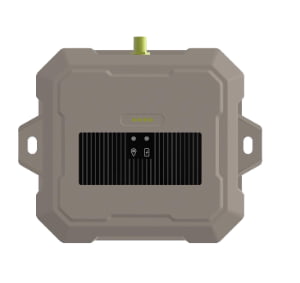
  • Battery‑powered WX/XB wireless UWB beacons are mounted on tunnel walls, brackets, or temporary structures without any cabling. Worker tags communicate with the nearest beacon, which forwards ranging data over 4G to the RTLS server. Beacons can be added or relocated as the tunnel advances, making the system ideal for brownfield projects, short headings, or temporary cross‑passage works. The same GridRTLS platform is used, so workers can move between wired and wireless sections without changing tags.

Key Advantages

  • No signal or power cabling required inside the tunnel; minimal civil work.
  • Very fast deployment and easy relocation as the heading advances.
  • Good fit for retrofit, temporary, or remote projects where installing PoE infrastructure is not economical.

Limitations / When Not To Use

  • Depends on stable 4G / private LTE coverage; additional network work may be required in some tunnels.
  • Battery replacement must be planned (typical life several years depending on reporting rate).
  • Not recommended for extremely high tag densities or sub‑second update requirements.

Notes: Choose this architecture for retrofit tunnels, temporary works, or early stages of a project where you need safety visibility quickly and will decide later whether to install a permanent wired system.

Architecture Components / Layers

Sensing layer – Worker tags & helmets

Same tag family as the wired architecture. Devices periodically send UWB bursts to nearby beacons and report battery and status information. Profiles can be adjusted (e.g. 1–2 Hz vs. 5–10 Hz) to balance accuracy and battery life.

Wireless beacon layer – Cable‑free UWB beacons

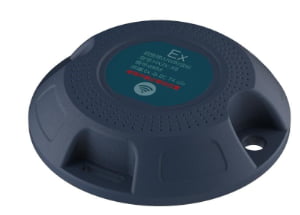
WX and XB beacons are powered by long‑life batteries and mounted where coverage is needed. Each beacon forms a micro‑cell of 50–100 m and can be installed or relocated in minutes, with no impact on existing tunnel structures. Beacons are IP67/68 and intrinsically safe for use in hazardous zones.

4G / LPWAN backhaul

Beacons use integrated 4G (or private LTE) to push positioning data to the RTLS server. Where cellular coverage is weak, repeaters or on‑site small cells can be used. The design minimizes cabling and is particularly suited to temporary or remote tunnel segments.

RTLS server & cloud integration

Same GridRTLS RTLS platform as in the wired architecture. For some projects the server can be hosted in the cloud rather than on‑site, as long as backhaul latency and reliability meet safety requirements.

Workflow

This workflow applies to all architecture options above. Specific hardware selection varies depending on the chosen architecture.

1

Site Survey & Tunnel Layout Design

Carry out a joint survey with the construction and safety teams. Collect tunnel drawings, cross‑section types, planned headings, cross passages, shafts, refuge chambers, and gas monitoring points. Decide where one‑dimensional corridor positioning is sufficient and where full 2D positioning is required (e.g. caverns, portals, underground stations). Define preferred communication paths – wireless bridge vs. fiber – based on tunnel length and available cable routes.

Estimated time: 3–5 days for a single‑tunnel project
2

UWB Anchor / Beacon Installation

Install dual‑channel STD tunnel anchors or SW UWB anchors along the tunnel walls at calculated intervals (typically 100–300 m depending on curvature and line‑of‑sight). Anchors are mounted 3–5 m above the roadway and powered via PoE or DC. In segments where wiring is difficult, deploy battery‑powered WX/XB wireless beacons to create local cells and backhaul data over 4G. Commission each anchor, verify ranging quality, and record its exact chainage and side (left/right) in the RTLS design.

Estimated time: 1–2 weeks depending on tunnel length
3

Tag & Helmet Distribution

Assign UWB wearables such as SH wristbands, GP employee badges, or AQM hybrid safety helmets to all workers, supervisors, and key visitors. Map device IDs to personnel records, crew codes, and access levels (e.g. allowed headings, hazardous sections, refuge chambers). Where vehicle tracking is required, equip mucking trucks, locomotives, and service vehicles with WZ magnetic asset tags or URTC vehicle terminals to achieve people–vehicle correlation.

Estimated time: 1–3 days including registration
4

Safety Rules, E‑Fences & Integrations

Configure electronic fences for dangerous sections such as blasting zones, gas risk areas, and cross passage construction faces. Define alarms for SOS button press, long‑time no‑movement, unauthorized entry, and overcrowding in a section. Integrate gas detectors, fan status, and CCTV where available so that alarms can automatically pop up camera views or gas trends for the exact tunnel chainage where an incident is detected.

Estimated time: 3–7 days including testing
5

System Go‑Live & Training

Run a pilot with one or two headings first. Validate positioning accuracy, alarm latency, and wireless backhaul stability during actual shifts. Train supervisors, safety officers, and dispatchers on daily routines: checking who is underground, printing muster lists, replaying historical tracks, and acknowledging alarms. After acceptance, roll out to all headings and establish regular maintenance routines for anchors, beacons, and tags.

Estimated time: 1–2 weeks including pilot and adjustments

Key Outcomes

<30 cm
Positioning accuracy in tunnel sections
Corridor‑mode accuracy using STD dual‑channel anchors in clear line‑of‑sight tunnel segments.
1–10 Hz
Refresh rate
Adjustable by profile; lower rates for long‑term projects, higher rates for high‑risk headings and vehicle interaction zones.
40–60% reduction
Reduction in emergency evacuation / search time
Faster locating of trapped or missing workers thanks to last‑seen location, real‑time tracks, and automatic muster lists.
100% of workers in monitored sections
Tunnel visibility
Every person who enters the instrumented tunnel with a registered tag or helmet is visible on the map and included in statistics, improving compliance and reporting.

Recommended Products

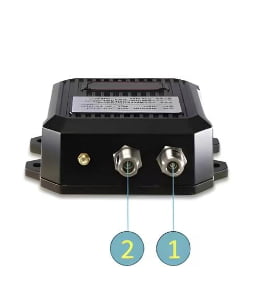
A black STD Dual channel base station with two ports on the front, each labeled with blue circles containing numbers 1 and 2.

STD UWB Dual Channel Base Station

The STD UWB Dual-Channel Base Station is an industrial-grade positioning device designed for tunnel, mining, and underground environments.

View Product
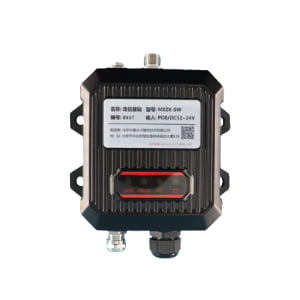
A black SW UWB Anchor device with labeled ports and a sticker showing specs, featuring indicator lights for LWB, GNSS, and 4G.

SW UWB Anchor

The SW UWB Positioning Base Station is an industrial-grade device designed for sub-meter accuracy tracking of personnel, vehicles, and assets in factories, tunnels, and other complex environments.

View Product
Gray rectangular electronic device with a black panel, LED indicators, and two side mounting flanges; a yellow cable extends from the top—designed as a WX UWB Beacon for advanced positioning applications.

WX UWB Wireless Positioning Beacon

The WX UWB Wireless Positioning Beacon is a battery-powered industrial-grade UWB device designed for wireless deployment without cable installation.

View Product
A dark gray, dome-shaped electronic device with a circular label featuring Chinese text and a Wi-Fi signal icon on the top surface.

XB UWB Wireless Positioning Beacon

The XB UWB Wireless Positioning Beacon is a compact, fully wireless, and battery-powered UWB device designed for high-precision positioning without cable deployment.

View Product
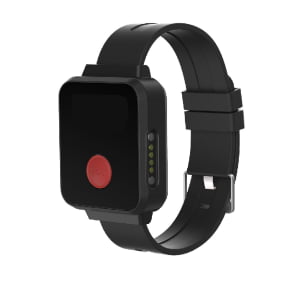
A black smartwatch with a rectangular face, black band, and a prominent red SOS button on the front.

SH UWB Positioning Wristband Tag

The SH UWB Positioning Wristband Tag is a high-precision wearable device designed for real-time personnel tracking and safety monitoring in industrial environments such as factories, construction sites, and tunnels.

View Product
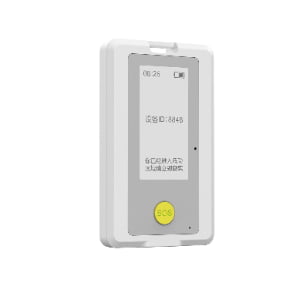
A rectangular white device with a screen displaying Chinese text, a time reading 08:26, an ID number, and a yellow SOS button below the display.

GP UWB Positioning Employee Card

The GP UWB Positioning Employee Card is a compact, intelligent badge-style positioning device designed for industrial personnel management and safety monitoring. Built on UWB (Ultra-Wideband) technology, it achieves 10–30 cm accuracy, supports real-time location tracking, and enables instant SOS alerts via a one-touch button. The device includes vibration reminders, motion/static detection, and optional NFC/RFID, E-ink display, and LoRa communication modules. With an IP66-rated enclosure and 900 mAh rechargeable battery, it operates continuously in demanding environments such as factories, construction sites, logistics parks, and tunnels.

View Product
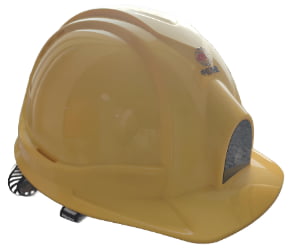
A yellow construction hard hat with a small transparent window on the front and an adjustable strap at the back.

AQM Hybrid Positioning Safety Helmet

The AQM Hybrid Positioning Safety Helmet is an industrial-grade smart helmet integrating UWB high-precision positioning, RTK centimeter-level positioning, GPS outdoor positioning, and 4G full-network communication. Designed for worker safety and real-time visibility, it features SOS emergency alerts, TTS voice, motion/static detection, low-battery warnings, and optional NFC / LoRa / 5G communication. With an IP56 rugged rating and a built-in 3000mAh rechargeable battery, the AQM helmet is ideal for construction sites, tunnels, factories, mining, ports, and hazardous environments requiring precise personnel tracking and safety protection.

View Product

Bill of Materials

Example BOM (based on the recommended architecture above)

ModelSummary
STD UWB Dual Channel Base StationThe STD UWB Dual-Channel Base Station is an industrial-grade positioning device designed for tunnel, mining, and underground environments.
SW UWB AnchorThe SW UWB Positioning Base Station is an industrial-grade device designed for sub-meter accuracy tracking of personnel, vehicles, and assets in factories, tunnels, and other complex environments.
WX UWB Wireless Positioning BeaconThe WX UWB Wireless Positioning Beacon is a battery-powered industrial-grade UWB device designed for wireless deployment without cable installation.
XB UWB Wireless Positioning BeaconThe XB UWB Wireless Positioning Beacon is a compact, fully wireless, and battery-powered UWB device designed for high-precision positioning without cable deployment.
SH UWB Positioning Wristband TagThe SH UWB Positioning Wristband Tag is a high-precision wearable device designed for real-time personnel tracking and safety monitoring in industrial environments such as factories, construction sites, and tunnels.
GP UWB Positioning Employee CardThe GP UWB Positioning Employee Card is a compact, intelligent badge-style positioning device designed for industrial personnel management and safety monitoring. Built on UWB (Ultra-Wideband) technology, it achieves 10–30 cm accuracy, supports real-time location tracking, and enables instant SOS alerts via a one-touch button. The device includes vibration reminders, motion/static detection, and optional NFC/RFID, E-ink display, and LoRa communication modules. With an IP66-rated enclosure and 900 mAh rechargeable battery, it operates continuously in demanding environments such as factories, construction sites, logistics parks, and tunnels.
AQM Hybrid Positioning Safety HelmetThe AQM Hybrid Positioning Safety Helmet is an industrial-grade smart helmet integrating UWB high-precision positioning, RTK centimeter-level positioning, GPS outdoor positioning, and 4G full-network communication. Designed for worker safety and real-time visibility, it features SOS emergency alerts, TTS voice, motion/static detection, low-battery warnings, and optional NFC / LoRa / 5G communication. With an IP56 rugged rating and a built-in 3000mAh rechargeable battery, the AQM helmet is ideal for construction sites, tunnels, factories, mining, ports, and hazardous environments requiring precise personnel tracking and safety protection.

Example Configuration

STD UWB Dual Channel Base Station (Installed along both directions of the main tunnel, spaced 200–250 m apart on side walls; provides 1D corridor positioning and redundancy over approximately 3 km.)
Qty: 18
SW UWB Anchor (Used at portals, caverns, and large underground chambers where 2D positioning or additional coverage is required.)
Qty: 6
WX UWB Wireless Positioning Beacon (Deployed in sections where cabling is difficult (cross passages, temporary headings); each beacon creates a local cell and backhauls data over 4G.)
Qty: 10
SH UWB Positioning Wristband Tag (Assigned to tunnel workers and supervisors for real‑time tracking, SOS, and no‑movement alarms.)
Qty: 220
GP UWB Positioning Employee Card (Used for contractor staff, inspectors, and visitors who enter the tunnel occasionally.)
Qty: 40
AQM Hybrid Positioning Safety Helmet (Used in high‑risk headings where UWB + RTK fusion positioning and voice prompts are required.)
Qty: 30
URTC Vehicle-Mounted Hybrid Positioning Terminal (Installed on mucking trucks, locomotives, or spray rigs to correlate vehicle movement with workers for people–vehicle interaction analysis.)
Qty: 12

Compliance & Regulations

Local tunnel safety and occupational health regulations

Owner / EPC HSE standards

🌍 Industries using this solution

Related Technical Resources

FAQs

Ready to Deploy?

Planning a new tunnel or metro project? Share your alignment drawings and basic crew size, and we’ll return a suggested UWB layout and BOM so you can compare options before tender or construction.

Contact Sales
Procurement (Device & Data Layer)

Shortlisting devices? Get an RFQ-ready BOM path.

Move from product selection to an actionable RFQ: scope boundaries, terms, lead time, and deliverables.

Contact Sales

Ready to Deploy RTLS?

Share your site layout and accuracy needs--we'll suggest a practical setup.

Contact Us