Skip to content
Industrial UWB RTLS for Real-Time Visibility
Menu

Slope & Tank Deformation Monitoring with GPS RTK

Unstable slopes and aging tank foundations are among the highest-risk assets on any industrial site. A few millimetres of unnoticed movement, repeated over weeks or months, can eventually lead to landslides, tank tilt, foundation cracking or loss of containment. Traditional visual inspections and periodic total-station surveys are labour-intensive, weather-dependent and often miss the early stages of deformation.

The Slope & Tank Deformation Monitoring solution uses static GPS RTK sensors and a local reference station to measure displacement of slopes, embankments, retaining walls and tank foundations with millimetre-level accuracy. Each monitoring node continuously tracks its position relative to the reference station and reports changes in three dimensions – vertical settlement, horizontal movement and tilt – through an industrial communication gateway to the central platform.

Solution Details

Category
Positioning Infrastructure
Industries
Construction Industrial Maintenance & Utilities Mining Oil & Gas Transportation & Rail
Environments
Yard Outdoor
Implementation
complex

Overview

Unstable slopes and aging tank foundations are among the highest-risk assets on any industrial site. A few millimetres of unnoticed movement, repeated over weeks or months, can eventually lead to landslides, tank tilt, foundation cracking or loss of containment. Traditional visual inspections and periodic total-station surveys are labour-intensive, weather-dependent and often miss the early stages of deformation.

The Slope & Tank Deformation Monitoring solution uses static GPS RTK sensors and a local reference station to measure displacement of slopes, embankments, retaining walls and tank foundations with millimetre-level accuracy. Each monitoring node continuously tracks its position relative to the reference station and reports changes in three dimensions – vertical settlement, horizontal movement and tilt – through an industrial communication gateway to the central platform.

The system is designed for harsh industrial environments such as open-pit mines, waste dumps, highway or rail cuttings, tailings facilities and oil tank farms. Hardware is fully outdoor-rated and supports continuous operation under rain, dust, temperature swings and vibration. When displacement exceeds configured thresholds, the system automatically generates alarms, visualises the affected area on the map and can notify operators by SMS, email or integration with the DCS / safety system.

Compared with periodic surveying, this architecture provides 24/7 deformation monitoring and a continuous history of displacement for every slope or tank. It allows engineers and safety teams to detect slow trends early, plan targeted inspections, adjust loading and schedule remediation work before a minor movement becomes a major incident.

Pain Points

Slope and tank deformation is only checked periodically

Many sites still rely on monthly or quarterly total-station surveys and visual inspections. Between campaigns, slow movement of slopes, embankments or tanks can go undetected, and early warning signs are only discovered when cracks or leakage are already visible.

Limited measurement points and incomplete coverage

Conventional surveying typically measures only a handful of control points. Complex slopes, long embankments or large tank farms require dozens of instruments for reliable coverage, which quickly becomes impractical to survey manually on a regular basis.

No real-time alerts or integration with safety systems

Even when geotechnical instruments are installed, data is often downloaded locally and processed offline. Without a real-time platform and configurable alarm thresholds, changes in displacement or tilt are not acted on quickly, and information does not reach the control room or HSE team in time.

Difficult correlation between deformation and operations

If monitoring data is stored separately from production, weather and loading information, it is hard to understand how rainfall, filling levels, blasting or material movement contribute to slope or tank behaviour. This makes root-cause analysis and mitigation planning slower and more uncertain.

Harsh environments and long distances challenge conventional sensors

Slopes and tank farms are often located in remote or exposed areas with strong winds, dust, corrosive atmospheres and large temperature swings. Running wired instrumentation across hundreds of metres can be expensive, and some sensor types are not designed for continuous outdoor exposure.

System Architectures & Topology

Refinery Tank Farm Deformation Monitoring

Architecture ID: Refinery Tank Farm Deformation Monitoring

Yard Outdoor Hazardous / Tank Farm
  • A GPS RTK reference station provides centimetre and millimetre-level accuracy for static monitoring terminals installed on tank shells and foundations. Each tank is equipped with several GPS RTK nodes mounted on the rim, shell or nearby structures. Nodes send displacement data via industrial gateways to the monitoring server, which visualises settlement, tilt and horizontal movement for every tank and triggers alarms when thresholds are exceeded.

Key Advantages

  • Designed specifically for large above-ground storage tanks and bunded tank farms
  • Detects settlement and tilt early, before structural damage or leakage occurs
  • Centralised view of all tanks with trend analysis and alarm thresholds
  • Can be integrated with existing safety and integrity management systems

Limitations / When Not To Use

  • Requires stable mounting positions with good sky visibility near each tank
  • Very congested steel structures or strong RF interference may reduce performance
  • For buried tanks or underground structures, complementary sensor technologies may still be required

Notes: Recommended for refineries, chemical plants and fuel depots where tank integrity is part of the major accident prevention strategy.

Architecture Components / Layers

Reference layer – GPS RTK base station

Provides a stable reference coordinate for the entire tank farm. Installed on a rigid structure with excellent sky visibility and reliable power, it continuously generates RTK corrections for all monitoring nodes.

Tank monitoring layer – static GNSS nodes

Static GPS RTK monitoring terminals are installed on tank shells, roofs or surrounding structures. They measure settlement, tilt and horizontal movement of each tank over time with millimetre-level precision.

Communication layer – industrial gateways

Gateways collect deformation data from monitoring nodes and transmit it securely to the central server over LPWAN or 4G, ensuring reliable communication even in hazardous or restricted areas.

Platform & analytics layer

The monitoring platform stores displacement histories, generates trend plots for each tank and supports configurable warning and alarm thresholds. Dashboards show which tanks are stable, which require closer observation and which need immediate intervention.

Open-Pit Mine & Slope Deformation Monitoring

Architecture ID: slope_mine_gps_rtk

Yard Outdoor
  • A GPS RTK reference station overlooking the mine provides corrections for static monitoring nodes installed on critical slopes, waste dumps and haul-road embankments. Each node is mounted on a stable pole or rock anchor and reports displacement to the monitoring platform via gateways. The platform displays displacement vectors and trends for each slope section, allowing geotechnical teams to detect movement early and set up targeted inspections or evacuation plans.

Key Advantages

  • Provides continuous deformation monitoring for high-risk mine slopes and embankments
  • Early warning of accelerating movement enables timely evacuation and remediation
  • Supports correlation with rainfall, blasting and production activities
  • Scalable from a single slope pilot to full-mine coverage

Limitations / When Not To Use

  • Requires careful geotechnical design and interpretation – it is a monitoring tool, not a replacement for engineering judgement
  • Dense forest cover or very narrow canyons can limit satellite visibility and may require alternative or complementary technologies
  • Hardware installation on steep or inaccessible slopes must follow strict safety procedures

Notes: This architecture is particularly suitable for open-pit mines, waste dumps, highway or rail cuttings and other large earthworks where ground movement poses a risk to people, equipment and production.

Architecture Components / Layers

Reference layer – mine GPS RTK base station

Located on a stable structure with line-of-sight to most of the mine, the base station provides RTK corrections to all slope monitoring nodes, enabling millimetre-level displacement measurements.

Slope monitoring layer – static GNSS nodes

Monitoring nodes are installed on benches, crests and toes of critical slopes and waste dumps. They continuously measure small displacements caused by excavation, blasting, rainfall or groundwater changes.

Communication layer – gateways and backhaul

Gateways connect remote slopes and dumps to the monitoring server using LPWAN or 4G links. They are installed on masts or buildings with power, providing reliable coverage across the pit and surrounding areas.

Platform layer – geotechnical dashboards and alarms

The platform visualises all monitored slopes, shows vector arrows for movement direction and magnitude, and provides time-series plots for each node. Alarm rules highlight areas with accelerating displacement or movement beyond acceptable thresholds.

Workflow

This workflow applies to all architecture options above. Specific hardware selection varies depending on the chosen architecture.

1

Geotechnical assessment and monitoring plan

Work with geotechnical engineers to identify critical slopes, embankments, dams and tanks that require continuous monitoring. Define potential failure modes, expected displacement directions and allowable movement thresholds. From this, derive the number of monitoring points, required accuracy and update interval.

Estimated time: 2–4 weeks
2

GPS RTK reference station and network design

Select a stable structure, such as a building roof or reinforced mast, for the GPS RTK reference station. Verify clear sky visibility and structural stability. Design the communication network and power supply for the reference station and monitoring nodes, considering redundancy and lightning protection.

Estimated time: 2–3 weeks
3

Installation of slope and tank monitoring nodes

Install static GPS RTK monitoring terminals on selected slope benches, crest lines, retaining walls and tank shells or foundations. Use corrosion-resistant brackets with good mechanical coupling to the structure. Commission each node, ensure sufficient satellite visibility, and verify measurement repeatability against baseline readings.

Estimated time: 4–6 weeks depending on site access
4

Platform configuration, thresholds and alerts

Connect all monitoring nodes to the central platform via industrial gateways. Configure displacement channels for each point (vertical, horizontal, tilt) and define warning and alarm thresholds in line with engineering criteria. Set up visual dashboards, historical plots and automatic notification channels (SMS, email or integration with the safety system).

Estimated time: 2–3 weeks
5

Integration with inspections and long-term analysis

Integrate monitoring outputs into routine inspections, maintenance and risk review processes. Use trends and event histories to correlate deformation with rainfall, filling operations or blasting. Periodically review thresholds, add or relocate sensors where needed, and extend the system to new slopes or tanks as the site grows.

Estimated time: Ongoing; quarterly reviews recommended

Key Outcomes

2–5 mm
Minimum detectable displacement at monitoring points
Static GPS RTK monitoring nodes can detect vertical and horizontal movements in the order of a few millimetres, allowing engineers to see slow trends long before visible cracks or tilt appear.
50–70% reduction
Reduction in manual survey workload
Routine deformation checks and elevation measurements are automated, so survey teams can focus on periodic validation and special investigations rather than repetitive campaigns.
Minutes response
Time to detect abnormal movement
Real-time monitoring and alerting reduce detection time from weeks between survey campaigns to minutes after thresholds are exceeded.
>90% of high‑risk assets
Coverage of critical slopes, embankments and tanks
A well-designed layout ensures that most geotechnically critical structures are instrumented with at least one monitoring point, and large slopes or tank farms have multiple sensors for redundancy.

Recommended Products

A modern white table lamp with a cylindrical base and a dome-shaped shade, shown against a plain white background.

GNSS Differential Reference Station

A high-precision GNSS/Beidou differential reference station that provides centimeter-level RTK corrections and sub-meter static accuracy. Supports RTCM differential data output, 4G/WiFi backhaul, UWB optional transmission, and fully integrates with positioning platforms for mining, ports, factories, and outdoor infrastructure.

View Product
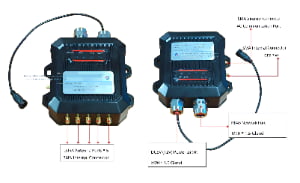
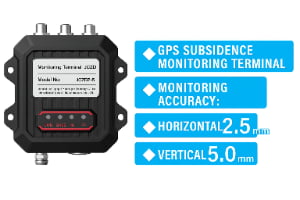
GPS subsidence monitoring terminal JCZD device front view showing model label and indicator panel.

JCZD GNSS Displacement & Settlement Monitoring Terminal

A high-precision GNSS-based monitoring terminal designed for real-time displacement and settlement monitoring in landslides, mining slopes, dam structures, reservoir embankments, tank subsidence, and roadbed deformation. Accuracy: ±2.5 mm horizontal / ±5 mm vertical. Supports GNSS differential positioning, 4G/RJ45 communication, fusion positioning algorithms, and outdoor IP67 deployment.

View Product
English-labeled diagram showing TXWG communication gateway ports including SMA, 4G, GPS, RJ45, LORA antenna ports, and power input.

TXWG Industrial Communication Gateway

A high-performance LPWAN-based industrial communication gateway designed for long-distance, low-power IoT communication. It supports LORA self-organizing networking, 4G cloud transmission, GPS time sync, multi-channel data forwarding, and explosion-proof applications.

View Product
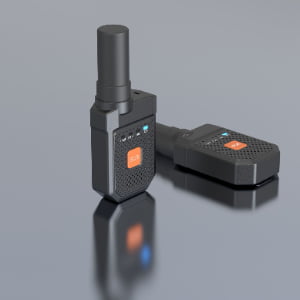
Two black handheld communication devices with visible SOS buttons and indicator lights are placed on a reflective gray surface.

URT Hybrid Positioning Terminal

The URT Hybrid Positioning Terminal is an industrial-grade wearable tracking device that integrates UWB high-precision positioning, RTK centimeter-level positioning, GPS outdoor positioning, and 4G wireless communication. It provides real-time personnel tracking, SOS emergency alerts, TTS voice broadcasting, motion detection, and optional NFC/Lora/5G expansion. With an IP66 rugged design and a 3000mAh magnetic-charging battery, the URT terminal is ideal for complex industrial environments such as factories, tunnels, construction sites, rail transit, and energy facilities.

View Product
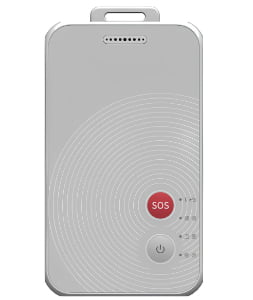
A white emergency alert device with a large red SOS button, a power button, indicator lights, and a speaker grille at the top.

UBK UWB + GPS Hybrid Positioning Badge

The UBK UWB + GPS Hybrid Positioning Badge is a rugged industrial-grade personnel tracking card designed for high-precision positioning in factories, warehouses, tunnels, and other demanding environments. It integrates UWB centimeter-level positioning with GPS outdoor positioning, features SOS emergency button, motion detection, TTS voice broadcast, 4G cellular communication, and optional NFC functionality. Equipped with a 3000mAh rechargeable battery and an IP66 protection rating, the UBK badge ensures reliable real-time personnel visibility and safety monitoring both indoors and outdoors.

View Product

Bill of Materials

Example BOM (based on the recommended architecture above)

ModelSummary
GNSS Differential Reference StationA high-precision GNSS/Beidou differential reference station that provides centimeter-level RTK corrections and sub-meter static accuracy. Supports RTCM differential data output, 4G/WiFi backhaul, UWB optional transmission, and fully integrates with positioning platforms for mining, ports, factories, and outdoor infrastructure.
JCZD GNSS Displacement & Settlement Monitoring TerminalA high-precision GNSS-based monitoring terminal designed for real-time displacement and settlement monitoring in landslides, mining slopes, dam structures, reservoir embankments, tank subsidence, and roadbed deformation. Accuracy: ±2.5 mm horizontal / ±5 mm vertical. Supports GNSS differential positioning, 4G/RJ45 communication, fusion positioning algorithms, and outdoor IP67 deployment.
TXWG Industrial Communication GatewayA high-performance LPWAN-based industrial communication gateway designed for long-distance, low-power IoT communication. It supports LORA self-organizing networking, 4G cloud transmission, GPS time sync, multi-channel data forwarding, and explosion-proof applications.
URT Hybrid Positioning TerminalThe URT Hybrid Positioning Terminal is an industrial-grade wearable tracking device that integrates UWB high-precision positioning, RTK centimeter-level positioning, GPS outdoor positioning, and 4G wireless communication. It provides real-time personnel tracking, SOS emergency alerts, TTS voice broadcasting, motion detection, and optional NFC/Lora/5G expansion. With an IP66 rugged design and a 3000mAh magnetic-charging battery, the URT terminal is ideal for complex industrial environments such as factories, tunnels, construction sites, rail transit, and energy facilities.
UBK UWB + GPS Hybrid Positioning BadgeThe UBK UWB + GPS Hybrid Positioning Badge is a rugged industrial-grade personnel tracking card designed for high-precision positioning in factories, warehouses, tunnels, and other demanding environments. It integrates UWB centimeter-level positioning with GPS outdoor positioning, features SOS emergency button, motion detection, TTS voice broadcast, 4G cellular communication, and optional NFC functionality. Equipped with a 3000mAh rechargeable battery and an IP66 protection rating, the UBK badge ensures reliable real-time personnel visibility and safety monitoring both indoors and outdoors.

Example Configuration

GNSS Differential Reference Station (Installed on a stable building or mast to provide high-precision reference data for all static monitoring nodes across the mine, slope or tank farm.)
Qty: 1
JCZD GNSS Displacement & Settlement Monitoring Terminal (Deformation monitoring nodes mounted on critical slope benches, crests, retaining walls and tank foundations or shells.)
Qty: 30
TXWG Industrial Communication Gateway (LPWAN / 4G gateways aggregating displacement data from monitoring nodes in remote or hazardous areas and forwarding it securely to the server.)
Qty: 3
URT Hybrid Positioning Terminal (Mobile RTK devices used by survey and geotechnical teams to validate static nodes, perform temporary measurements and support commissioning.)
Qty: 5

Compliance & Regulations

Supports geotechnical and dam safety guidelines

Evidence for risk assessments and inspections

Supports major accident prevention and integrity programs

🌍 Industries using this solution

FAQs

Ready to Deploy?

If you operate mines, slopes or tank farms where structural stability is a major concern, we can help you design a practical GPS RTK deformation monitoring layout. Share a basic site plan, the number of slopes and tanks, and your current inspection practices, and our team will prepare a draft sensor layout, example thresholds and a phased deployment plan.

Contact Sales
Procurement (Device & Data Layer)

Shortlisting devices? Get an RFQ-ready BOM path.

Move from product selection to an actionable RFQ: scope boundaries, terms, lead time, and deliverables.

Contact Sales

Ready to Deploy RTLS?

Share your site layout and accuracy needs--we'll suggest a practical setup.

Contact Us