Skip to content
Industrial UWB RTLS for Real-Time Visibility
Menu

Overhead Crane RTLS & Anti-Collision System

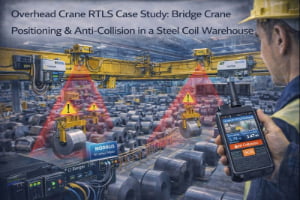
Overhead cranes are the backbone of heavy manufacturing and steel handling. They move ladles, coils, plates, molds and large assemblies over workers, production lines and storage areas. In many plants, several cranes share the same runway or cross above each other. Operators rely on line-of-sight, horn signals and simple end-stop switches to avoid collisions.

The Overhead Crane RTLS & Anti-Collision solution adds a precise positioning and distance layer to crane operations. UWB ranging devices and collision units mounted on each crane continuously measure distance to other cranes, end stops and defined obstacles. At the same time, optional anchors and RTLS infrastructure provide continuous position tracking along the runway and across the bay, so you always know where each crane is and which zones are occupied.

Solution Details

Category
Asset RTLS & Anti-Collision
Industries
Industrial Maintenance & Utilities Manufacturing
Environments
Factory Warehouse Yard
Implementation
complex

Overview

Overhead cranes are the backbone of heavy manufacturing and steel handling. They move ladles, coils, plates, molds and large assemblies over workers, production lines and storage areas. In many plants, several cranes share the same runway or cross above each other. Operators rely on line-of-sight, horn signals and simple end-stop switches to avoid collisions.

The Overhead Crane RTLS & Anti-Collision solution adds a precise positioning and distance layer to crane operations. UWB ranging devices and collision units mounted on each crane continuously measure distance to other cranes, end stops and defined obstacles. At the same time, optional anchors and RTLS infrastructure provide continuous position tracking along the runway and across the bay, so you always know where each crane is and which zones are occupied.

Depending on the risk level, the system can provide step-by-step warnings—first visual and audible alerts to operators, then automatic slow-down, and finally enforced stops via relays into the crane’s safety chain, according to standards and your internal rules. All movements and near-miss events can be recorded, giving maintenance and HSE teams objective data for improving layouts, procedures and training.
Pain Points

High risk of crane–crane and crane–structure collisions

On many runways, multiple overhead cranes share the same tracks. Operators rely on experience and line-of-sight to keep safe distances. In low visibility, during heavy load handling or near end stops, it is easy to misjudge distance and speed, causing collisions between cranes or against mechanical end stops and structures.

No precise, continuous position information for cranes

Standard limit switches and encoders only provide coarse position information and are not always connected to supervisory systems. Operations and maintenance teams often lack a live overview of crane positions along the runway and across bays, making it harder to coordinate movements or diagnose problems.

Limited protection for workers in crane working areas

Workers may need to enter areas near crane runways, hooks and suspended loads for rigging, inspection or maintenance. Without a way to detect people in defined no-go zones or restricted areas, safety relies entirely on procedures and communication.

Difficult and time-consuming incident reconstruction

After a collision or near-miss, it is hard to reconstruct exactly where cranes were, how fast they were moving and how close they approached each other or fixed obstacles. Paper logs and operator memories do not give enough detail to drive technical improvements.

System Architectures & Topology

UWB Distance-Based Anti-Collision for Overhead Cranes

Architecture ID: crane_anticollision_uwb

Factory Warehouse
  • Each overhead crane is equipped with UWB ranging terminals and anti-collision units. Devices on the cranes measure distance to fixed reference points and, where configured, directly to other cranes on the same runway. When the distance falls below configured thresholds, the system issues visual and audible warnings to the operator and, via relay outputs, can slow down or stop the crane according to the agreed safety strategy. This architecture focuses on reliable distance-based collision avoidance along the runway and near end stops without requiring a full RTLS map of the entire plant.

Key Advantages

  • Focused solution for crane–crane and crane–structure collision risks
  • No need for full RTLS infrastructure to achieve core safety goals
  • Integration with crane controls via standard relay interfaces
  • Strong fit for retrofits where cranes are already in service

Limitations / When Not To Use

  • Provides limited or no map-based visualisation of crane positions without additional RTLS infrastructure
  • Does not on its own provide person tracking or heatmaps of crane utilisation
  • Requires careful design and testing of integration with existing crane control systems

Notes: Recommended for plants that want to add a distance-based anti-collision layer to existing cranes with minimal changes to building infrastructure.

Architecture Components / Layers

Crane-mounted UWB ranging layer

UWB ranging terminals on the crane measure distance along the runway to fixed points or to other cranes. These measurements are used to calculate position along the track and enforce minimum separation distances and end-stop protections.

Anti-collision unit layer

Collision units or radar devices provide distance-based protection between cranes and obstacles. They generate alarms for the operator and offer relay outputs for speed limitation or stop functions via crane PLC or safety relays.

Crane control integration layer

Relay outputs from anti-collision units are wired into the crane’s control or safety circuits according to engineering design. This allows staged responses, such as slow-down when entering a buffer zone and stop before impact, while ensuring compliance with electrical and safety standards.

Monitoring & diagnostics layer

Alarm states and basic distance information can be monitored through local HMIs or a simple monitoring interface, giving maintenance and HSE teams visibility into device status and frequent alarm locations.

Plant RTLS for Overhead Cranes with Integrated Anti-Collision and Analytics

Architecture ID: crane_rtls_full

Factory Warehouse
  • This architecture combines crane-mounted anti-collision devices with a full RTLS infrastructure across the workshop. UWB anchors are installed along runways and across bays, allowing the RTLS server to calculate crane positions in real time. Crane-mounted terminals report position and anti-collision events to the RTLS platform, while edge devices on the cranes still perform fast local distance checks. Personnel tags can be added to monitor workers near crane paths and restricted zones. The result is a complete map of crane movements, safety events and zone occupancy, supporting both safety and operational optimisation.

Key Advantages

  • Combines local anti-collision with full RTLS visibility and analytics
  • Enables advanced use cases such as utilisation analysis, flow optimisation and crew coordination
  • Supports integration with existing plant systems via open interfaces
  • Provides a strong data backbone for continuous improvement in crane safety and operations

Limitations / When Not To Use

  • Requires more infrastructure (anchors, server, network integration) than anti-collision alone
  • Project scoping and commissioning are more involved and need close cooperation with crane and plant engineering teams
  • For simple single-crane lines, a pure anti-collision architecture may be sufficient

Notes: Recommended for plants that see crane safety and utilisation as strategic topics and plan to use RTLS more broadly across equipment, vehicles and personnel.

Architecture Components / Layers

Anchor and reference layer – RTLS infrastructure

SN2 and SW anchors are installed in the building to form a positioning grid along crane runways and around key work areas. They provide the reference signals needed for precise, continuous crane and personnel positioning.

Crane-mounted positioning and anti-collision layer

Crane-mounted UWB ranging terminals and anti-collision units provide both local collision avoidance and RTLS sensing. They communicate with anchors for positioning and with crane controls for local slow-down and stop logic.

Personnel tag layer

Workers who enter crane bays, walkways or areas under hook paths wear UWB tags. Combined with crane RTLS, this allows geofenced alerts when people are present in restricted areas while cranes are operating.

RTLS server and safety analytics layer

The RTLS server calculates crane and personnel positions, manages zones and rules, records events and generates dashboards. It can provide heatmaps of crane utilisation, statistics on near-miss events and history for incident analysis and planning.

Workflow

This workflow applies to all architecture options above. Specific hardware selection varies depending on the chosen architecture.

1

Crane and runway survey

Survey each bay and runway with the maintenance and operations teams. Record the number and type of overhead cranes, runway lengths, typical working areas, lifting heights, end-stop positions, cross-overs and shared zones. Identify the most critical collision risks: crane–crane contact, crane–end-stop impacts, crane–structure collisions and any crane–person interaction areas.

Estimated time: 3–5 days for a typical multi-bay workshop
2

Anti-collision and positioning design

For each runway, design the positioning and anti-collision scheme. Select UWB ranging units and collision radars for cranes, decide where to mount them (usually on crane girders or end carriages) and where to place reference points or reflectors on the rails. Define safe separation distances between cranes, slow-down and stop thresholds and any special logic needed for shared or cross-over zones. If RTLS anchors are added, determine their locations along the runway and in the bay.

Estimated time: 1–3 weeks including detailed engineering and approvals
3

Installation on cranes and infrastructure deployment

Install UWB ranging terminals, anti-collision units and antennas on each crane according to the design. Connect relay outputs to the crane PLC or safety relays to enable speed limiting and stop commands according to agreed safety levels. Mount any required reference beacons or anchors along the runway and bay. Run power and communication cables, or configure wireless backhaul where required.

Estimated time: Planned during maintenance windows; typically 1–3 days per crane line
4

Commissioning, zone configuration and operator training

Commission each crane by verifying distance measurements to other cranes, end stops and obstacles. Fine-tune warning and stop distances based on actual braking performance and load scenarios. Configure any no-go or restricted zones where crane movement must be limited. Train operators, maintenance staff and supervisors on system behaviour, alarm meanings and procedures for fault handling and bypass in controlled conditions.

Estimated time: 2–4 weeks for full system verification and training
5

Continuous monitoring, optimisation and integration

Monitor alarm statistics, near-miss events and operator feedback. Adjust thresholds and zones where necessary to avoid nuisance alarms while preserving safety margins. If the system is integrated with RTLS, use movement histories and heatmaps to identify congested zones, evaluate crane utilisation and support planning of modifications to rails or work practices. Establish a maintenance and inspection routine for anti-collision devices alongside normal crane inspections.

Estimated time: Ongoing; first optimisation loop typically within 4–8 weeks

Key Outcomes

-50–80% reduction
Crane–crane and crane–end-stop collision incidents
Typical long-term reduction when anti-collision devices and improved operating rules are combined.
+80–95% events recorded
Near-miss events at critical separation distance
More near-miss events are detected and logged compared to relying only on operator reports and occasional observation.
-60–80% reduction
Time to locate and identify crane positions for operations**
RTLS maps and dashboards remove the need for repeated radio calls and manual checks to see where each crane is.
-30–50% reduction
Time required to reconstruct incidents and analyse root causes
Position histories and distance logs give a clear timeline of movements before and during an incident.

Recommended Products

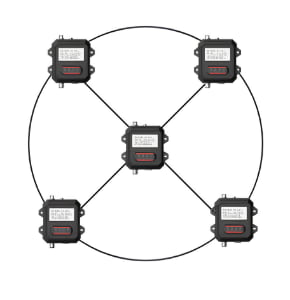
CJ distance measurement terminals forming a five-node mesh topology for industrial positioning

CJ Industrial Ranging Terminal

A high-precision industrial distance-measurement terminal supporting 1-to-1, 1-to-many, and many-to-many real-time ranging. Offers up to 10 cm accuracy, long-distance transmission (≥1000 m), strong anti-interference, IP67 protection, 24/7 stable operation, and is designed for harsh industrial applications such as overhead cranes, trolleys, mining vehicles, and material-handling machinery.

View Product
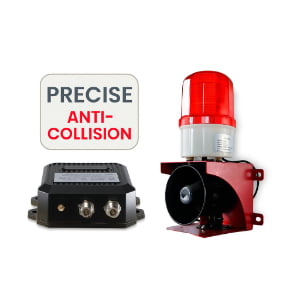
Main product image of the FZ anti-collision radar and audio-visual alarm with ‘Precise Anti-Collision’ label.

FZ Industrial Collision Avoidance Radar

The FZ Collision Avoidance Radar is a high-precision industrial anti-collision device designed for vehicles, loaders, forklifts, cranes, and mining trucks. It supports a detection distance over 100 meters, 30 cm accuracy, dual-relay output, strong anti-interference capability, and IP67 protection for harsh industrial environments.

View Product
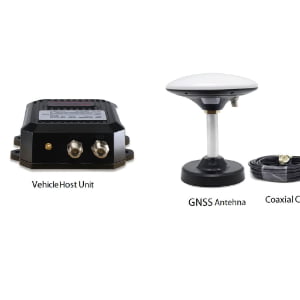
A vehicle host unit, GNSS antenna, and coaxial cable are displayed separately on a white background with labels.

URTC Vehicle-Mounted Hybrid Positioning Terminal

The URTC Vehicle-Mounted Hybrid Positioning Terminal integrates RTK centimeter-level positioning, optional UWB <30 cm indoor positioning, and a GNSS full-constellation system, enabling high-precision positioning for industrial vehicles, engineering machinery, cranes, and fleet applications. With a separated-module design using coaxial cable connection, the URTC terminal achieves RTK accuracy of ±3 cm, supports 4G full-netcom communication, anti-collision functions, and performs reliably in harsh industrial environments with IP67 protection, wide temperature tolerance, and strong signal reception.

View Product
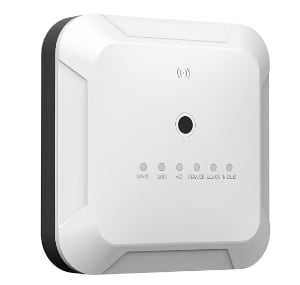
Side view of UWB base station with status indicators.

SN2 UWB PoE Anchor

The SN2 is an industrial‑grade UWB positioning anchor designed for high‑accuracy real‑time location systems. It supports Standard PoE or 12–24 V DC power, delivers sub‑meter performance (<30 cm LoS), and features an IP66 enclosure for harsh indoor/outdoor environments. Multiple mounting options (ceiling, wall, pole clamp) make deployment easy in factories, warehouses, and tunnels. Optional 4G/Wi‑Fi backhaul, AI video add‑on, and sound‑light alarm extend the anchor’s capability for safety and analytics. (Actual performance depends on anchor density, layout, and site RF conditions.)

View Product
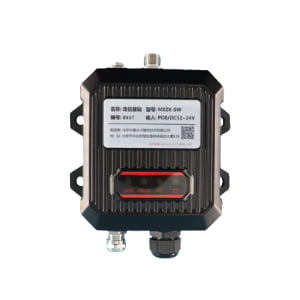
A black SW UWB Anchor device with labeled ports and a sticker showing specs, featuring indicator lights for LWB, GNSS, and 4G.

SW UWB Anchor

The SW UWB Positioning Base Station is an industrial-grade device designed for sub-meter accuracy tracking of personnel, vehicles, and assets in factories, tunnels, and other complex environments.

View Product
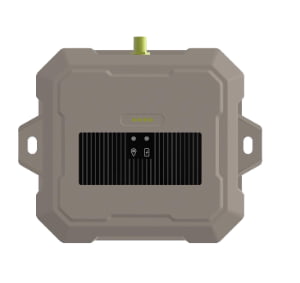
Gray rectangular electronic device with a black panel, LED indicators, and two side mounting flanges; a yellow cable extends from the top—designed as a WX UWB Beacon for advanced positioning applications.

WX UWB Wireless Positioning Beacon

The WX UWB Wireless Positioning Beacon is a battery-powered industrial-grade UWB device designed for wireless deployment without cable installation.

View Product
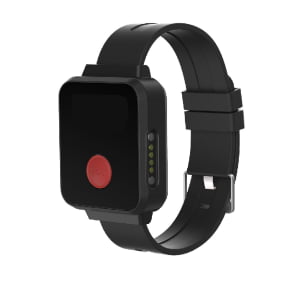
A black smartwatch with a rectangular face, black band, and a prominent red SOS button on the front.

SH UWB Positioning Wristband Tag

The SH UWB Positioning Wristband Tag is a high-precision wearable device designed for real-time personnel tracking and safety monitoring in industrial environments such as factories, construction sites, and tunnels.

View Product
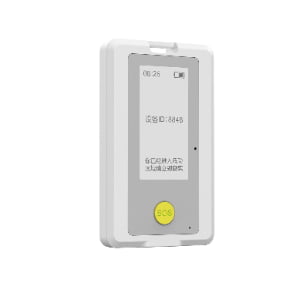
A rectangular white device with a screen displaying Chinese text, a time reading 08:26, an ID number, and a yellow SOS button below the display.

GP UWB Positioning Employee Card

The GP UWB Positioning Employee Card is a compact, intelligent badge-style positioning device designed for industrial personnel management and safety monitoring. Built on UWB (Ultra-Wideband) technology, it achieves 10–30 cm accuracy, supports real-time location tracking, and enables instant SOS alerts via a one-touch button. The device includes vibration reminders, motion/static detection, and optional NFC/RFID, E-ink display, and LoRa communication modules. With an IP66-rated enclosure and 900 mAh rechargeable battery, it operates continuously in demanding environments such as factories, construction sites, logistics parks, and tunnels.

View Product

Bill of Materials

Example BOM (based on the recommended architecture above)

ModelSummary
CJ Industrial Ranging TerminalA high-precision industrial distance-measurement terminal supporting 1-to-1, 1-to-many, and many-to-many real-time ranging. Offers up to 10 cm accuracy, long-distance transmission (≥1000 m), strong anti-interference, IP67 protection, 24/7 stable operation, and is designed for harsh industrial applications such as overhead cranes, trolleys, mining vehicles, and material-handling machinery.
FZ Industrial Collision Avoidance RadarThe FZ Collision Avoidance Radar is a high-precision industrial anti-collision device designed for vehicles, loaders, forklifts, cranes, and mining trucks. It supports a detection distance over 100 meters, 30 cm accuracy, dual-relay output, strong anti-interference capability, and IP67 protection for harsh industrial environments.
URTC Vehicle-Mounted Hybrid Positioning TerminalThe URTC Vehicle-Mounted Hybrid Positioning Terminal integrates RTK centimeter-level positioning, optional UWB <30 cm indoor positioning, and a GNSS full-constellation system, enabling high-precision positioning for industrial vehicles, engineering machinery, cranes, and fleet applications. With a separated-module design using coaxial cable connection, the URTC terminal achieves RTK accuracy of ±3 cm, supports 4G full-netcom communication, anti-collision functions, and performs reliably in harsh industrial environments with IP67 protection, wide temperature tolerance, and strong signal reception.
SN2 UWB PoE AnchorThe SN2 is an industrial‑grade UWB positioning anchor designed for high‑accuracy real‑time location systems. It supports Standard PoE or 12–24 V DC power, delivers sub‑meter performance (<30 cm LoS), and features an IP66 enclosure for harsh indoor/outdoor environments. Multiple mounting options (ceiling, wall, pole clamp) make deployment easy in factories, warehouses, and tunnels. Optional 4G/Wi‑Fi backhaul, AI video add‑on, and sound‑light alarm extend the anchor’s capability for safety and analytics. (Actual performance depends on anchor density, layout, and site RF conditions.)
SW UWB AnchorThe SW UWB Positioning Base Station is an industrial-grade device designed for sub-meter accuracy tracking of personnel, vehicles, and assets in factories, tunnels, and other complex environments.
WX UWB Wireless Positioning BeaconThe WX UWB Wireless Positioning Beacon is a battery-powered industrial-grade UWB device designed for wireless deployment without cable installation.
SH UWB Positioning Wristband TagThe SH UWB Positioning Wristband Tag is a high-precision wearable device designed for real-time personnel tracking and safety monitoring in industrial environments such as factories, construction sites, and tunnels.
GP UWB Positioning Employee CardThe GP UWB Positioning Employee Card is a compact, intelligent badge-style positioning device designed for industrial personnel management and safety monitoring. Built on UWB (Ultra-Wideband) technology, it achieves 10–30 cm accuracy, supports real-time location tracking, and enables instant SOS alerts via a one-touch button. The device includes vibration reminders, motion/static detection, and optional NFC/RFID, E-ink display, and LoRa communication modules. With an IP66-rated enclosure and 900 mAh rechargeable battery, it operates continuously in demanding environments such as factories, construction sites, logistics parks, and tunnels.

Example Configuration

CJ Industrial Ranging Terminal (Mounted on overhead cranes and along the runway as reference points to measure distance and calculate crane position along the track.)
Qty: 8
FZ Industrial Collision Avoidance Radar (Installed on crane end carriages facing the track and towards other cranes or end stops, providing high-precision distance measurements and relay outputs for slow-down and stop functions.)
Qty: 8
SN2 UWB PoE Anchor (Installed in the bay to create a positioning grid for RTLS, enabling live crane positions, maps and movement histories across the workshop.)
Qty: 24
SH UWB Positioning Wristband Tag (Assigned to rigging teams, maintenance staff and operators who may work under or near crane paths when personnel monitoring is required.)
Qty: 80
GP UWB Positioning Employee Card (For supervisors, visiting engineers and technical staff who need to be included in muster and safety reporting.)
Qty: 40

Compliance & Regulations

Support for crane operation and safety procedures

Traceable records for incidents and audits

Integration with existing control and safety layers

🌍 Industries using this solution

Related Technical Resources

FAQs

Ready to Deploy?

Running multiple overhead cranes on shared runways and want better control of collision risks? Share your bay layout, crane types and key hazards with us, and our engineers will propose a practical RTLS and anti-collision design for your plant.

Contact Sales
Procurement (Device & Data Layer)

Shortlisting devices? Get an RFQ-ready BOM path.

Move from product selection to an actionable RFQ: scope boundaries, terms, lead time, and deliverables.

Contact Sales

Ready to Deploy RTLS?

Share your site layout and accuracy needs--we'll suggest a practical setup.

Contact Us