Skip to content
Industrial UWB RTLS for Real-Time Visibility
Menu
Knowledge Base

UWB

Filter Resources

Clear all
Output Level
Technology Boundary
Architecture
Industry
Reset
How UWB RTLS Works

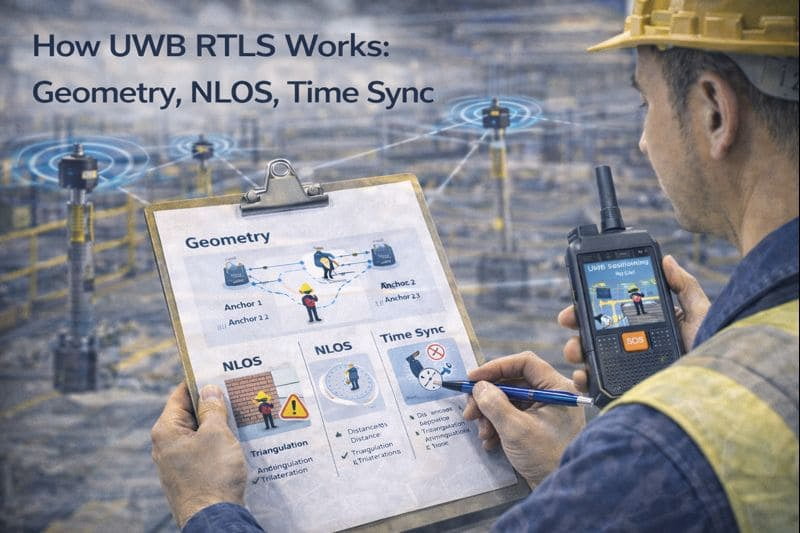
How UWB RTLS Works: Geometry, NLOS, and Time Synchronization

RTLS-grade UWB positioning is not “magic accuracy”—it is time measurement plus geometry plus clock discipline. Your best-case accuracy is set by anchor geometry (angles and visibility), while your worst-case accuracy is dominated by NLOS/multipath and time synchronization drift.<br /> <br /> If a deployment looks inconsistent, debug in this order: (1) anchor geometry and “anchors-in-view” count, (2) NLOS sources and first-path visibility, (3) time sync stability across anchors, then (4) update rate/filtering and coordinate calibration.
technology_guide14 min readintermediateUpdated Dec 2025
UWB vs GPS vs BLE for RTLS

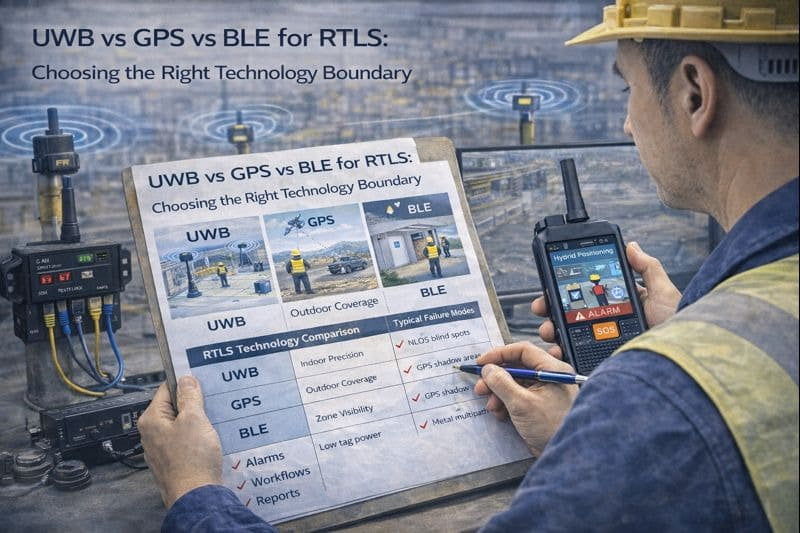
UWB vs GPS vs BLE for RTLS: Choosing the Right Technology Boundary

Industrial RTLS projects fail when teams compare technologies by “accuracy” alone. The real question is where each technology stops being reliable for your required operational events (zone entry/exit, proximity risk, dispatch timing, route compliance).<br /> <br /> Use UWB for deterministic indoor events and safety-critical proximity; use GPS RTK for outdoor yards and wide-area coverage; use BLE when your requirement is zone/presence visibility and ultra-low tag power. The best deployments draw a clear technology boundary and define testable acceptance criteria per boundary.
technology_guide12 min readintermediateUpdated Dec 2025

Ready to Deploy RTLS?

Share your site layout and accuracy needs--we'll suggest a practical setup.

Contact Us