Skip to content
Industrial UWB RTLS for Real-Time Visibility
Menu
Knowledge Base

Resources

Filter Resources

Clear all
Output Level
Technology Boundary
Architecture
Industry
Reset
RTLS System Architecture Overview

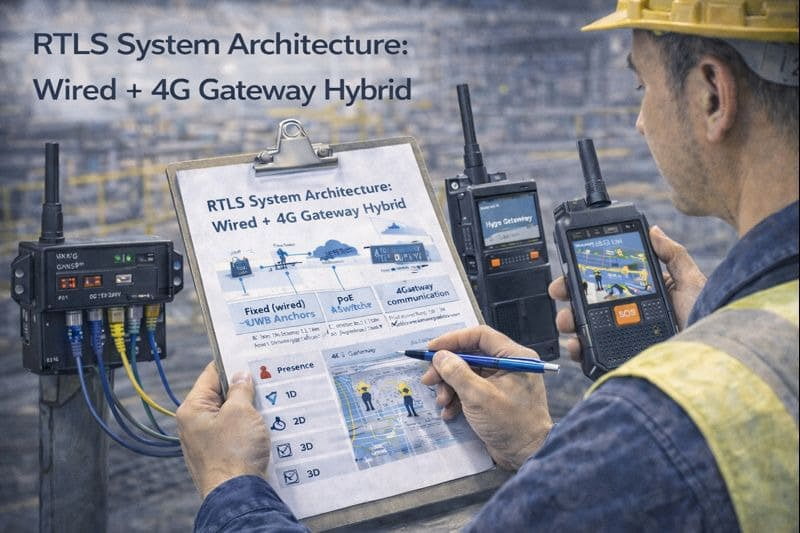
RTLS System Architecture Overview: Wired vs 4G vs Gateway vs Hybrid

RTLS failures are rarely caused by positioning accuracy alone. In real deployments, power supply, data backhaul, and failure isolation determine whether a system runs for years or becomes unmaintainable.<br /> <br /> Wired PoE architectures offer the highest stability, 4G architectures trade wiring for operational cost, gateway-based architectures solve “no public network” constraints, and hybrid architectures exist to balance indoor precision with outdoor coverage. The right choice depends on site constraints, maintenance model, and acceptable failure modes—not on radio technology alone.
architecture13 min readintermediateUpdated Dec 2025
How UWB RTLS Works

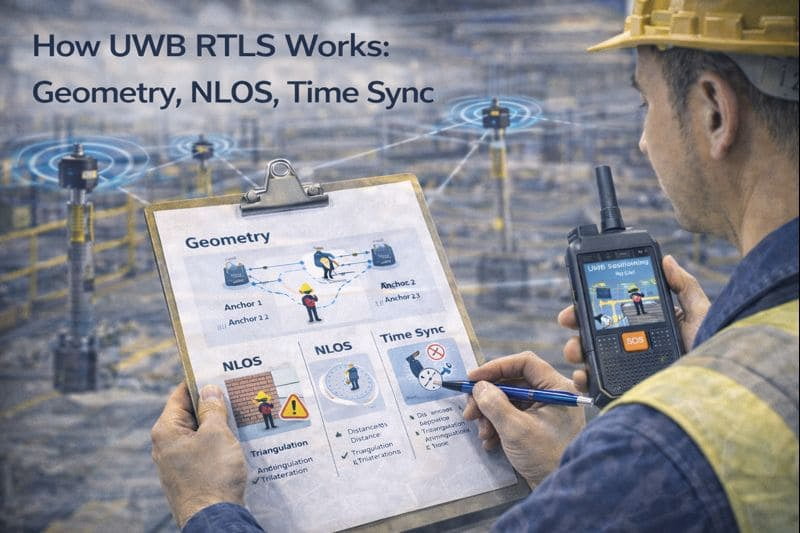
How UWB RTLS Works: Geometry, NLOS, and Time Synchronization

RTLS-grade UWB positioning is not “magic accuracy”—it is time measurement plus geometry plus clock discipline. Your best-case accuracy is set by anchor geometry (angles and visibility), while your worst-case accuracy is dominated by NLOS/multipath and time synchronization drift.<br /> <br /> If a deployment looks inconsistent, debug in this order: (1) anchor geometry and “anchors-in-view” count, (2) NLOS sources and first-path visibility, (3) time sync stability across anchors, then (4) update rate/filtering and coordinate calibration.
technology_guide14 min readintermediateUpdated Dec 2025

UWB vs GPS vs BLE for RTLS

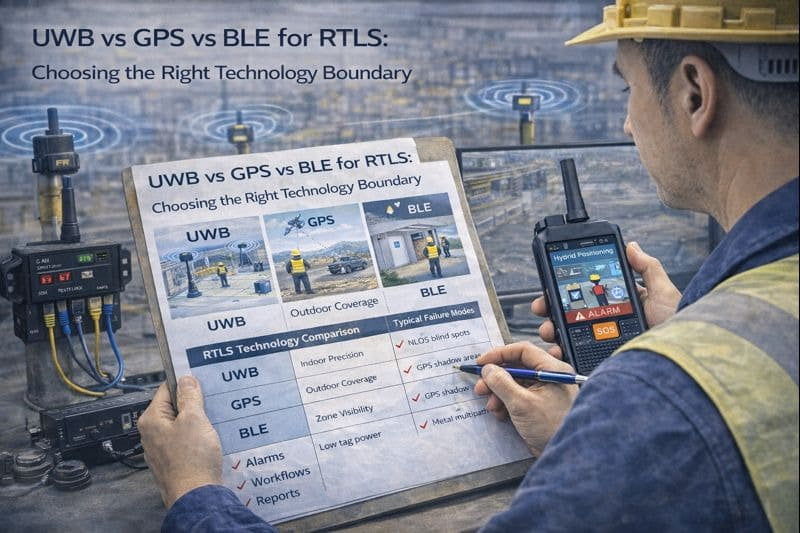
UWB vs GPS vs BLE for RTLS: Choosing the Right Technology Boundary

Industrial RTLS projects fail when teams compare technologies by “accuracy” alone. The real question is where each technology stops being reliable for your required operational events (zone entry/exit, proximity risk, dispatch timing, route compliance).<br /> <br /> Use UWB for deterministic indoor events and safety-critical proximity; use GPS RTK for outdoor yards and wide-area coverage; use BLE when your requirement is zone/presence visibility and ultra-low tag power. The best deployments draw a clear technology boundary and define testable acceptance criteria per boundary.
technology_guide12 min readintermediateUpdated Dec 2025
What Is RTLS?

What Is RTLS? A Practical Definition for Industrial Sites

RTLS (Real-Time Location System) should be defined by the operational outcomes you need—not by the sensor technology.<br /> In industrial sites, the real value is converting location into rule-based events (e.g., unauthorized entry, dwell time, near-miss risk)<br /> and then linking those events to alarms, video, and reporting.<br /> <br /> A practical RTLS design starts by choosing the output level you truly need (presence / 1D / 2D/3D), then selecting the right architecture<br /> (wired UWB, UWB over cellular, wiring-free UWB, or hybrid UWB + GNSS/BeiDou RTK) to match constraints such as wiring, public-network access,<br /> hazardous areas, and indoor–outdoor continuity.
technology_guide10 min readintermediateUpdated Dec 2025
Procurement (Device & Data Layer)

Shortlisting devices? Get an RFQ-ready BOM path.

Move from product selection to an actionable RFQ: scope boundaries, terms, lead time, and deliverables.

Ready to Deploy RTLS?

Share your site layout and accuracy needs--we'll suggest a practical setup.

Contact Us