
Skip to content
Industrial UWB RTLS for Real-Time Visibility
Menu
Knowledge Base

2D

Filter Resources

Clear all
Output Level
Technology Boundary
Architecture
Industry
Reset
RTLS Output Levels Explained

RTLS Output Levels Explained: Presence vs 1D vs 2D/3D

RTLS projects fail most often because the required output level is over-specified.<br /> Presence, 1D, and 2D/3D positioning are not “accuracy tiers” but different system designs with very different anchor density, installation complexity, and failure modes.<br /> <br /> Define the event you must trigger and the worst-case zone where it must work.<br /> If you ask for 2D/3D when presence or 1D would have solved the operational problem, you will pay more, deploy slower, and argue longer—without improving outcomes.
technology_guide11 min readintermediateUpdated Oct 2025
How UWB RTLS Works

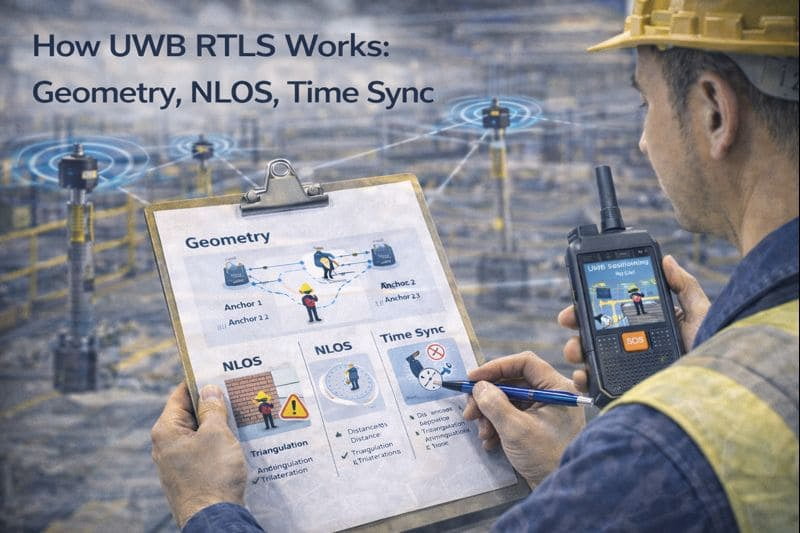
How UWB RTLS Works: Geometry, NLOS, and Time Synchronization

RTLS-grade UWB positioning is not “magic accuracy”—it is time measurement plus geometry plus clock discipline. Your best-case accuracy is set by anchor geometry (angles and visibility), while your worst-case accuracy is dominated by NLOS/multipath and time synchronization drift.<br /> <br /> If a deployment looks inconsistent, debug in this order: (1) anchor geometry and “anchors-in-view” count, (2) NLOS sources and first-path visibility, (3) time sync stability across anchors, then (4) update rate/filtering and coordinate calibration.
technology_guide14 min readintermediateUpdated Dec 2025
Procurement (Device & Data Layer)

Shortlisting devices? Get an RFQ-ready BOM path.

Move from product selection to an actionable RFQ: scope boundaries, terms, lead time, and deliverables.

Ready to Deploy RTLS?

Share your site layout and accuracy needs--we'll suggest a practical setup.

Contact Us