Skip to content
Industrial UWB RTLS for Real-Time Visibility
Menu
Knowledge Base

Resources

Filter Resources

Clear all
Output Level
Technology Boundary
Architecture
Industry
Reset
RTLS Requirements Template

RTLS Requirements Template: How to Write Specs Vendors Can Actually Deliver

Most RTLS procurement failures are not technical—they are contractual. Teams buy “accuracy” and later discover they needed event correctness in worst zones, with defined latency, retention, and operational handover.<br /> <br /> This template turns RTLS into a set of testable requirements: entities, zones, events, performance budgets, acceptance tests, infrastructure constraints, and deliverables. It is designed to produce quotes that are comparable and projects that can be signed off without endless disputes.
buyer_guide16 min readadvancedUpdated Nov 2025

RTLS Total Cost of Ownership

RTLS Total Cost of Ownership: PoE vs 4G vs Gateway vs Wiring‑Free Beacons

Most RTLS projects underestimate total cost because they price hardware, not operations. The real cost drivers are (1) power delivery, (2) backhaul management, (3) battery and SIM workload, and (4) how failures are isolated.<br /> <br /> PoE anchors usually have the lowest long-term cost when wiring is allowed. 4G reduces construction time but adds recurring SIM and coverage risk. Gateway-based designs are essential when public networks are restricted. Wiring-free UWB beacons accelerate retrofit deployments, but the battery lifecycle becomes a measurable operational workload that must be budgeted and scheduled.
architecture14 min readadvancedUpdated Dec 2025
RTLS Failure Modes

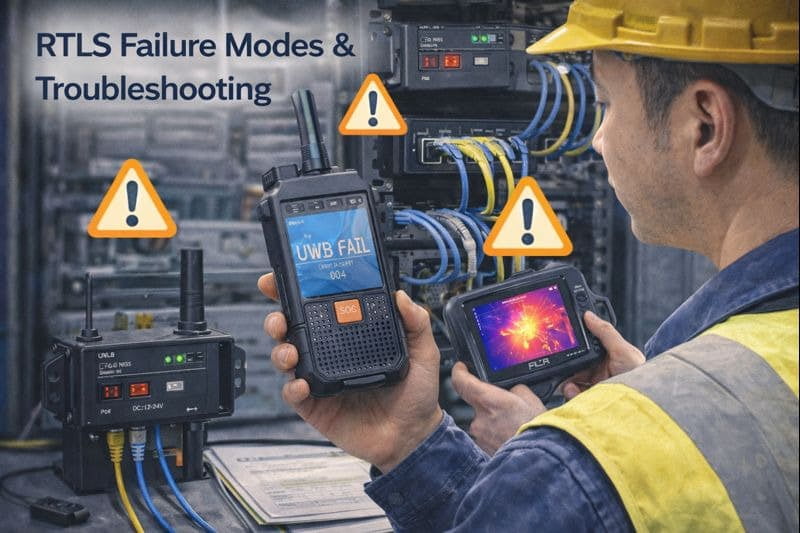
RTLS Failure Modes & Troubleshooting: What Breaks First in Real Projects

Most RTLS problems are not “accuracy issues.” They are system reliability issues caused by one of five breakpoints: power, time sync, geometry, network latency/loss, or event logic.<br /> <br /> Troubleshooting should follow a strict triage order: confirm anchor health → confirm time sync → confirm anchor participation in worst zones → confirm network end-to-end latency → only then tune filters or thresholds.
technology_guide15 min readadvancedUpdated Nov 2025
RTLS Deployment & Commissioning Checklist

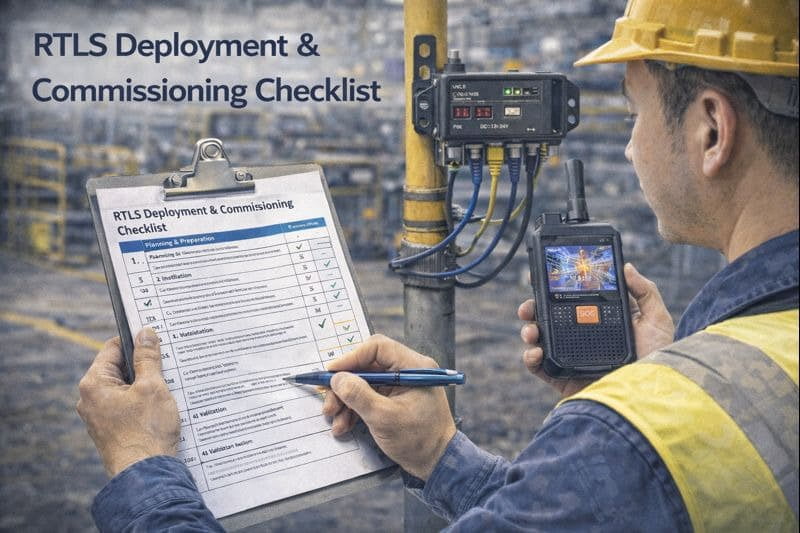
RTLS Deployment & Commissioning Checklist: From Site Survey to Go-Live

Most RTLS projects fail not during installation, but during commissioning and handover.<br /> A successful deployment follows a disciplined sequence: site survey → anchor layout → calibration → worst-zone testing → acceptance → operational handover.<br /> <br /> Skipping steps or compressing them into a “demo day” produces systems that look correct on maps but behave unpredictably in real operations.
architecture14 min readadvancedUpdated Dec 2025
RTLS Accuracy, Latency, and Update Rate

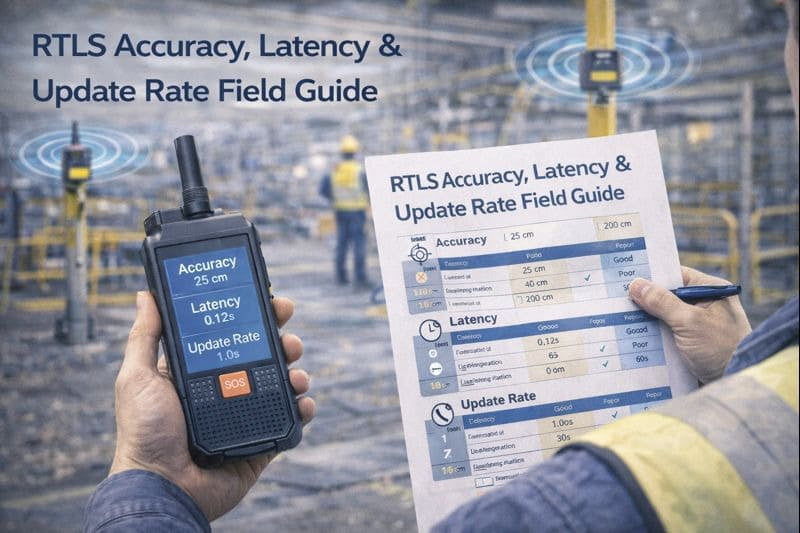
RTLS Accuracy, Latency, and Update Rate: What Really Matters in the Field

RTLS performance is not defined by accuracy alone. In real deployments, accuracy, latency, and update rate form a coupled system—optimizing one without understanding the others often makes the system worse.<br /> <br /> For safety and operations, the correct specification is event reliability in worst zones, bounded by acceptable latency and a realistic update rate. Systems that look “accurate” on paper but respond too slowly or too noisily fail operator trust.
technology_guide12 min readintermediate
RTLS Output Levels Explained

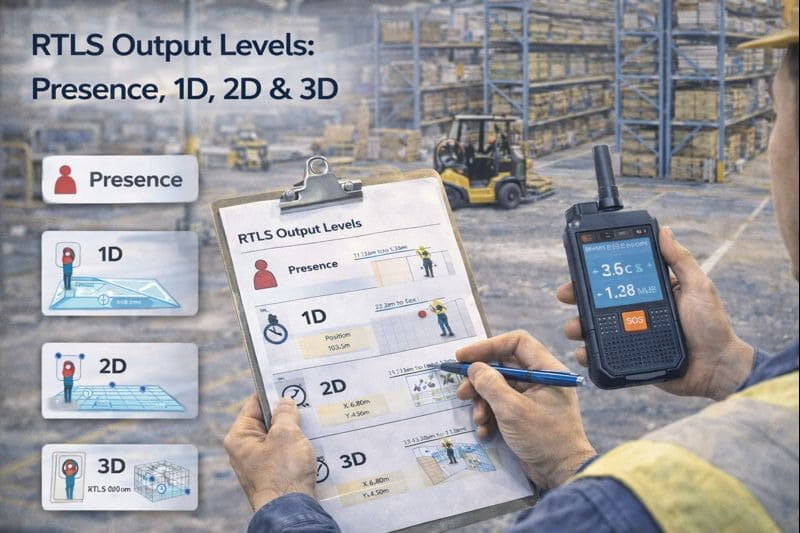
RTLS Output Levels Explained: Presence vs 1D vs 2D/3D

RTLS projects fail most often because the required output level is over-specified.<br /> Presence, 1D, and 2D/3D positioning are not “accuracy tiers” but different system designs with very different anchor density, installation complexity, and failure modes.<br /> <br /> Define the event you must trigger and the worst-case zone where it must work.<br /> If you ask for 2D/3D when presence or 1D would have solved the operational problem, you will pay more, deploy slower, and argue longer—without improving outcomes.
technology_guide11 min readintermediateUpdated Oct 2025
Procurement (Device & Data Layer)

Shortlisting devices? Get an RFQ-ready BOM path.

Move from product selection to an actionable RFQ: scope boundaries, terms, lead time, and deliverables.

Ready to Deploy RTLS?

Share your site layout and accuracy needs--we'll suggest a practical setup.

Contact Us