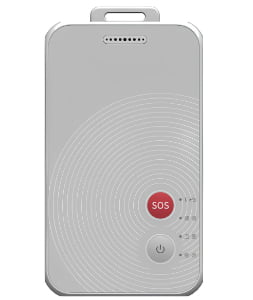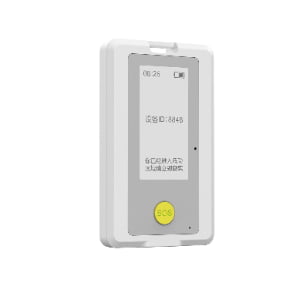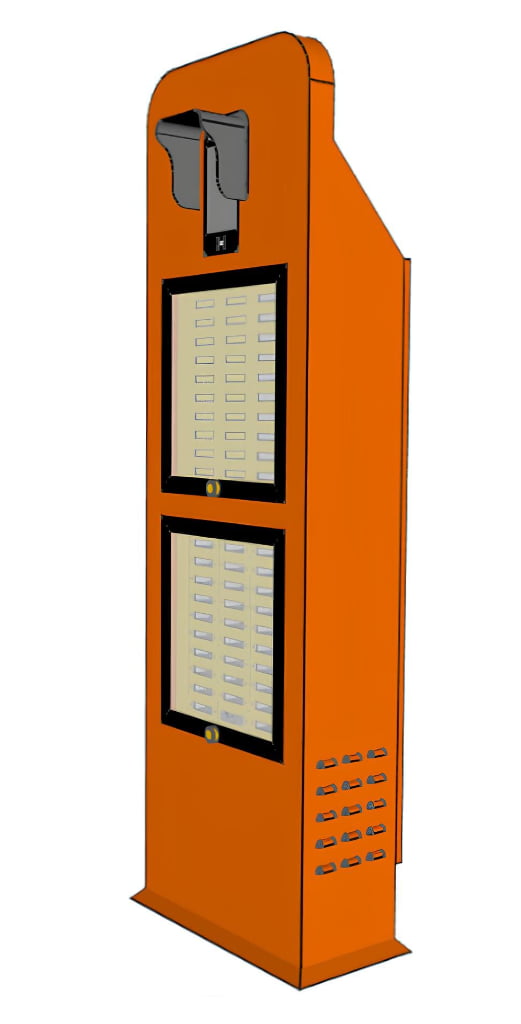
Overview
The FKJ Facial Recognition Automatic Card Dispenser is an advanced integrated device designed for large industrial sites that require precise personnel management and efficient card utilization. The system centralizes card dispensing, identification, charging, and return, creating a seamless and automated workflow for organizations managing large numbers of positioning devices.
Its counter-top cabinet design, industrial-grade metal housing, and 8-inch IPS facial recognition terminal provide a robust, scalable, and aesthetically improved management solution for both indoor and semi-outdoor environments.
Key Functions
1. Facial Recognition Card Dispensing
-
Users must complete face verification before retrieving a card.
-
Prevents unauthorized card collection, misidentification, and card swapping.
-
Enhances safety and accuracy in workforce tracking.
2. Dynamic Identity Binding
-
Each card is automatically and dynamically assigned to a specific individual, ensuring one-person-one-card.
-
Eliminates manual registration and reduces human errors.
3. Centralized Card Charging & Return
-
All slots support charging and card return automatically.
-
Ensures cards are always fully charged before shifts.
-
Reduces inventory requirements—three-shift factories can reduce card quantities by one-third.
4. Intelligent Management Platform
The FKJ integrates with a backend management platform for:
-
Card issuance records
-
Identity binding logs
-
Card return status
-
Battery overview
-
Remote device management
-
Face database updates
Supports both wired and 4G wireless communication, enabling deployment in varied environments.
Industrial Benefits
-
Improves workforce efficiency and safety
-
Eliminates chaotic or unsafe charging habits
-
Prevents card loss, damage, and misplacement
-
Increases utilization of positioning cards and reduces excess devices
-
Enhances company management image and overall workspace organization
System Architecture
The FKJ facial-recognition card dispenser supports two system architectures, enabling flexible deployment in different industrial environments. Depending on the customer’s infrastructure, the device can operate either through wired networking or 4G wireless communication, ensuring stability and adaptability in various site conditions.
Both architectures connect to the enterprise’s back-end management platform for real-time card issuance records, dynamic identity binding, remote management, and equipment monitoring.
① Wired Networking Architecture
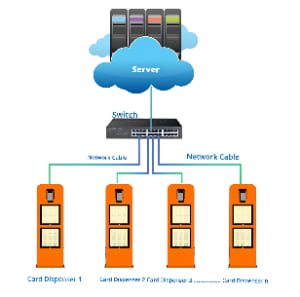
In the wired deployment model, each FKJ dispenser connects to the central server through a local area network (LAN). An industrial-grade switch is used to form a stable communication backbone.
Workflow
-
Each dispenser connects via network cable to the switch.
-
The switch unifies all connections and communicates with the central server.
-
The management platform receives real-time data, including:
-
Facial recognition results
-
Card issuance events
-
Battery level of each card
-
Card return records
-
Equipment status
-
Advantages
-
High stability: Ideal for factories with existing network infrastructure.
-
Low latency: Guarantees fast response times (<300 ms facial recognition).
-
High throughput: Supports large volumes of card operations across many devices.
-
Centralized monitoring: Unified and synchronized data flow.
According to the PDF system diagram, the wired architecture is shown on the left side of the schematic, where multiple dispensers connect through switch → server communication.
② 4G Wireless Architecture
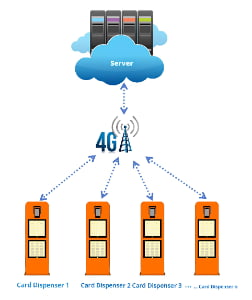
For environments where wired networks are not available or inconvenient to install—such as construction sites, temporary work zones, outdoor facilities, ports, or remote operation areas—the FKJ dispenser supports 4G wireless communication.
Workflow
-
Each dispenser integrates a 4G module and connects wirelessly to the server over the mobile network.
-
All card issuance, face recognition results, logs, and device states are transmitted through cellular data.
-
The server receives data from all deployed machines regardless of geographic spread.
Advantages
-
No wiring required: Fast deployment in locations lacking LAN infrastructure.
-
Flexible placement: Dispensers can be moved or relocated freely.
-
Wide coverage: Works in large outdoor areas where Wi-Fi/LAN cannot reach.
-
Supports distributed operations: Multiple devices across different sites can report to the same backend.
The 4G architecture diagram appears on the right side of the system illustration, showing multiple FKJ units communicating via a 4G base station to the cloud server.
Together, the wired and 4G wireless architectures ensure that the FKJ Facial Recognition Automatic Card Dispenser can be deployed in both fixed industrial facilities and dynamic or remote environments. Whether in manufacturing plants, chemical sites, energy stations, logistics hubs, or outdoor construction zones, the device maintains high reliability, seamless connectivity, and unified data management.