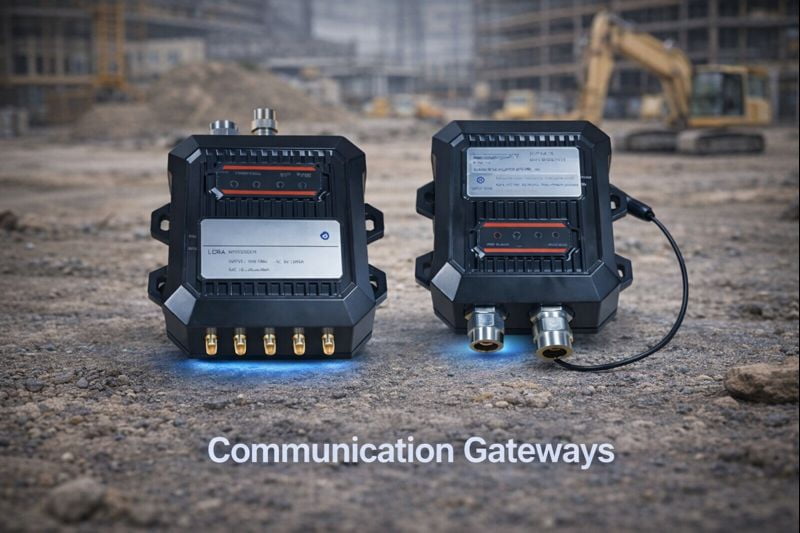
Communication gateways are a critical part of industrial RTLS and positioning systems, responsible for bridging field devices with local servers or cloud platforms when direct public network access is limited or unavailable.
GridRTLS provides industrial-grade communication gateways designed for reliable data transmission in harsh and complex environments such as chemical plants, factories, tunnels, mines, and large infrastructure sites.
GridRTLS supplies industrial communication gateways that bridge UWB RTLS field devices with local servers or cloud platforms.
This category focuses on the data transmission layer—how positioning data leaves the site reliably, securely, and at scale.
In real RTLS deployments, gateway reliability matters more than raw positioning accuracy.
Gateways determine whether data is delivered consistently across shifts, survives network interruptions,
and integrates cleanly with third-party positioning engines and customer platforms.
Our gateways are designed for industrial backhaul scenarios, supporting Ethernet,
private cellular (4G/5G), and local relay architectures where public network access may be limited or unavailable.
We primarily work with system integrators and engineering teams who already operate a positioning engine or RTLS platform
and need a stable, well-documented gateway layer to connect anchors, tags, and edge devices to their backend systems.
If you are selecting gateways for an RTLS project, this page is intended to help you
define communication architecture, backhaul options, and RFQ inputs,
and move toward an RFQ-ready gateway BOM without re-quoting later.
Designed for continuous operation in factories, tunnels, and outdoor sites where consumer networking equipment is not suitable.
Support Ethernet, private cellular (4G/5G), and local relay models to match site constraints and IT policies.
Gateways focus on data forwarding and protocol handling, leaving positioning logic to the customer’s RTLS engine or platform.
Consistent configuration and provisioning support pilot → rollout without gateway behavior changes between batches.
Clear integration notes, network requirements, and commissioning expectations for SI teams.
Ethernet, private cellular (4G/5G), or local relay. This defines hardware, SIM strategy, and network policy alignment.
Number of anchors/tags per gateway and refresh rate determine throughput and buffering requirements.
Define whether gateways must tolerate intermittent connectivity and how data buffering/retry should behave.
Specify expected data format, protocol, and whether data is forwarded raw or pre-processed.
Power source, mounting method, and environmental exposure (temperature, dust, vibration).
Firewall rules, private APN usage, VPN requirements, or on-premise routing constraints.
Pilot size vs rollout size affects provisioning workflow and revision control expectations.
For communication gateways, customization typically focuses on network configuration,
enclosure options, and deployment-specific parameters rather than core functionality.
We recommend keeping gateway logic stable and aligning customization with IT and security policies early.
OEM/ODM scope may include branding, enclosure adjustments, power options, and controlled firmware parameters.
Deeper customization affecting protocols or security models should be confirmed early,
as it impacts validation and long-term maintainability.
Logo, asset labels, packaging.
APN settings, static routing, VPN parameters.
DIN-rail mounting, extended temperature enclosure.
SIM strategy, carrier selection, private network alignment.
Firewall rules, certificate handling, IT validation workflow.
Pre-configured gateways for large rollouts.
Communication gateways sit between field devices and the customer platform.
From an integration perspective, they should be treated as data transport and routing components,
not positioning logic nodes.
Common solution patterns where this category is typically used.
Where this category is most commonly deployed.
Evidence that matters to SI teams: how we lock BOMs, keep batch consistency, and ship integration-ready hardware.
pcat_factory_photos to show real installation proof.
Gateway deployment may require alignment with customer IT and security policies
(firewall rules, private APN, VPN, or routing constraints).
These requirements should be defined before shipment.
Warranty coverage and RMA handling follow agreed procurement terms.
Clear batch identification and configuration records support efficient troubleshooting and replacement.
The gateway is responsible for data transport, not positioning logic.
It bridges field devices (anchors, tags, terminals) with the customer’s local server or cloud platform.
Position calculation, business rules, and visualization are typically handled by the RTLS engine, not the gateway.
Use Ethernet gateways when stable wired infrastructure is available on site.
Cellular gateways are more suitable for tunnels, mines, temporary sites, or locations with limited IT access.
The choice affects power design, SIM strategy, security policy, and long-term operating cost.
No. Gateways focus on data forwarding and basic protocol handling.
They do not perform UWB positioning calculations or application-level logic.
This separation keeps the system architecture flexible and easier to maintain.
Key RFQ inputs include backhaul method (Ethernet / 4G / 5G / local relay),
expected device count and data rate, network availability assumptions,
security or IT policy constraints, and deployment scale (pilot vs rollout).
Gateway capacity, buffering behavior, and provisioning workflow directly affect scalability.
Defining these parameters early helps ensure that pilot configurations can be reused
without redesign when moving to multi-site or large-scale deployment.
Gateways are typically configured to tolerate temporary network interruptions,
with basic buffering and retry behavior.
Exact behavior depends on configuration and should be aligned with the customer platform
during the integration phase.
No. Gateways are designed to integrate with third-party RTLS engines and platforms.
Integration is based on agreed data formats, protocols, and routing rules,
allowing SI teams to keep control of platform choice.
Typical considerations include firewall rules, private APN usage for cellular gateways,
VPN requirements, and routing policies.
These should be defined before shipment to avoid site delays or reconfiguration.
Gateway configuration, firmware parameters, and labeling are kept consistent across batches.
This helps SI teams deploy additional gateways without unexpected behavior differences
between pilot and rollout phases.
Define gateway role, backhaul method (Ethernet / 4G/5G / relay), throughput, and security requirements<br /> before RFQ. This helps SI teams lock communication architecture early and avoid re-quoting later.<br />
Share your site layout and accuracy needs--we'll suggest a practical setup.