Skip to content
Industrial UWB RTLS for Real-Time Visibility
Menu

Collision Avoidance

Industrial collision avoidance hardware for forklifts, cranes and mobile assets. Combine UWB/BLE/RTK with alerts, geofencing and safety automation.

Filter Products

Select a category and/or industry to narrow results.

Clear all
Product Category
Locked: Collision Avoidance
Industries

Supplier / Manufacturer Overview

GridRTLS supplies industrial collision avoidance systems
designed to reduce accident risk between vehicles, mobile equipment, and personnel.
This category focuses on safety response and alert behavior,
not on positioning accuracy or analytics dashboards.

FOCUS AREA

In safety-critical environments, knowing where something is matters less than
how fast and how reliably the system reacts.
Collision avoidance systems are built around low-latency detection,
predictable alert paths, and clear responsibility boundaries.

These systems typically operate alongside RTLS platforms but are not dependent on
full positioning accuracy to trigger safety responses.

WHO WE WORK WITH

We work with system integrators, safety engineers, and industrial solution providers
implementing collision warning or avoidance systems for forklifts, cranes,
heavy vehicles, and restricted personnel zones.

SYSTEM ROLE

  • Detect proximity or risk conditions based on defined thresholds.
  • Trigger alerts (visual, audible, vibration, or system-level signals).
  • Operate with predictable latency under industrial conditions.
  • Hand off logging and analytics to higher-level platforms if required.

If your project involves safety-critical interactions between people and equipment,
this page is intended to help you define alert logic, response paths,
and RFQ inputs
, and move toward an RFQ-ready safety system configuration.

Capability highlights

Low-latency detection and alerting

Designed to minimize response time between risk detection and alert output.

Clear alert paths

Supports audible, visual, vibration, or external system triggers depending on site rules.

Predictable behavior under load

Alert logic remains stable even in dense or noisy environments.

RTLS-compatible but safety-first

Can operate independently of full positioning accuracy when safety thresholds are met.

Scalable safety zones

Supports multiple vehicles, zones, and personnel groups without logic conflicts.

Selection criteria (what to specify in an RFQ)

1 Safety scenario definition

Vehicle–person, vehicle–vehicle, or restricted-zone entry.

2 Response time requirement

Maximum acceptable latency between detection and alert.

3 Alert method

Buzzer, light, vibration, display, or system signal output.

4 Trigger logic

Distance-based, zone-based, or rule-based conditions.

5 Environmental constraints

Dust, vibration, noise level, lighting, and temperature.

6 Integration boundary

Standalone alert vs integration with RTLS or safety platform.

7 Fail-safe behavior

Expected system response in case of signal loss or power interruption.

8 Deployment scale

Single site vs multi-site consistency requirements.

Customization / OEM / ODM

Customization for collision avoidance systems usually focuses on
alert behavior, thresholds, and integration interfaces
rather than cosmetic changes.
Because these systems are safety-related, customization scope
should be defined and validated early.

OEM/ODM projects may involve enclosure changes, alert hardware selection,
or system interface alignment.
Any change affecting detection logic or response timing should be treated
as a safety-critical modification.

Alert hardware configuration

Buzzer, light, vibration, or combined outputs.

Typical impact: medium
Trigger thresholds

Distance, zone size, or rule-based logic.

Typical impact: high
Interface to external systems

Digital output, network message, or platform API.

Typical impact: medium
Vehicle or asset mounting options

Mounting position affects detection behavior.

Typical impact: medium
Fail-safe logic

Behavior under communication or power failure.

Typical impact: high
Batch configuration control

Consistent safety behavior across deployments.

Typical impact: medium

Integration & architecture

Wired PoE / Ethernet Gateway Relay (Local / Private Net) LPWAN / Long-range Low Power

Collision avoidance systems should be integrated with a clear safety boundary.
They are responsible for detection and alerting, not incident analysis or reporting.

  • Define whether alerts are local-only or also sent to a platform.
  • Confirm latency expectations and validation method.
  • Align safety logic with site operating procedures.
  • Keep alert behavior consistent across vehicles and zones.
Supplier proof

Factory, delivery discipline & real deployments

Evidence that matters to SI teams: how we lock BOMs, keep batch consistency, and ship integration-ready hardware.

Config-first quoting
Align output level + site constraints before locking BOM to prevent re-quoting.
Batch consistency
Configuration and revision control across pilot → rollout to reduce maintenance risk.
Integration-ready delivery
Clear integration notes and commissioning expectations—no “mystery behavior” in the field.
QA & traceability
Pre-shipment verification + traceability mindset for multi-batch projects.
Read full supplier proof
Safety logic defined before delivery
Collision scenarios, trigger thresholds, and alert behavior
are aligned before shipment to avoid unsafe changes during site deployment.

Consistent behavior across batches
Safety systems must behave identically across vehicles and sites.
Batch configuration control ensures predictable response during rollout.

Scope boundaries
  • We supply collision avoidance hardware and integration documentation.
  • We do not operate site safety management or enforcement systems.
Scope boundaries (important)
  • Hardware + integration-ready documentation supplied; no on-site cabling / civil construction.
  • No turnkey RTLS platform operation for end customers; platform & site delivery handled by SI / partners.
Real deployments
Installation patterns & environments
Ceiling / wall mounting examples and industrial conditions.
Upload photos in pcat_factory_photos to show real installation proof.
Operating environment

Designed for industrial vehicle and site conditions.

EMC / industrial compliance

Suitable for electrically noisy environments.

Safety responsibility definition

Alert behavior and response ownership defined per project.

Warranty & RMA policy

Traceable batches support maintenance and replacement.

  • Trigger condition verification under controlled scenarios
  • Alert response timing and repeatability testing
  • Power stability and long-run operation checks
  • Environmental tolerance validation

FAQ

Is a collision avoidance system the same as RTLS?

No. RTLS provides location data; collision avoidance focuses on immediate safety response.

Does the system require high positioning accuracy?

No. It relies on proximity and trigger logic rather than exact coordinates.

How fast should alerts be triggered?

Latency requirements should be defined per scenario and validated during testing.

Can it work without a cloud platform?

Yes. Local alerting is common in safety-critical environments.

What types of alerts are supported?

Audible, visual, vibration, and system-level signals depending on configuration.

How are false alarms handled?

Through careful trigger definition and zone configuration.

Can it integrate with existing RTLS systems?

Yes, typically for logging or analysis, not for primary alert logic.

What happens if communication is lost?

Fail-safe behavior should be defined at RFQ stage.

How do you ensure consistent behavior across vehicles?

Through controlled configuration and batch validation.

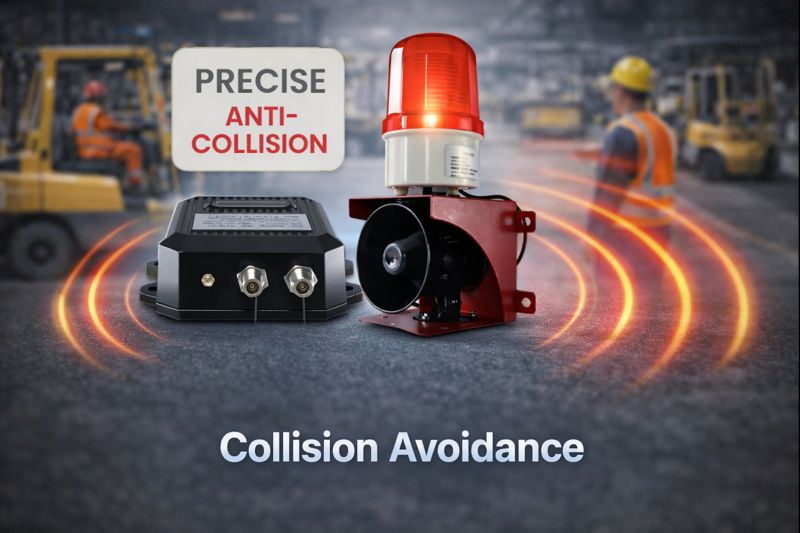
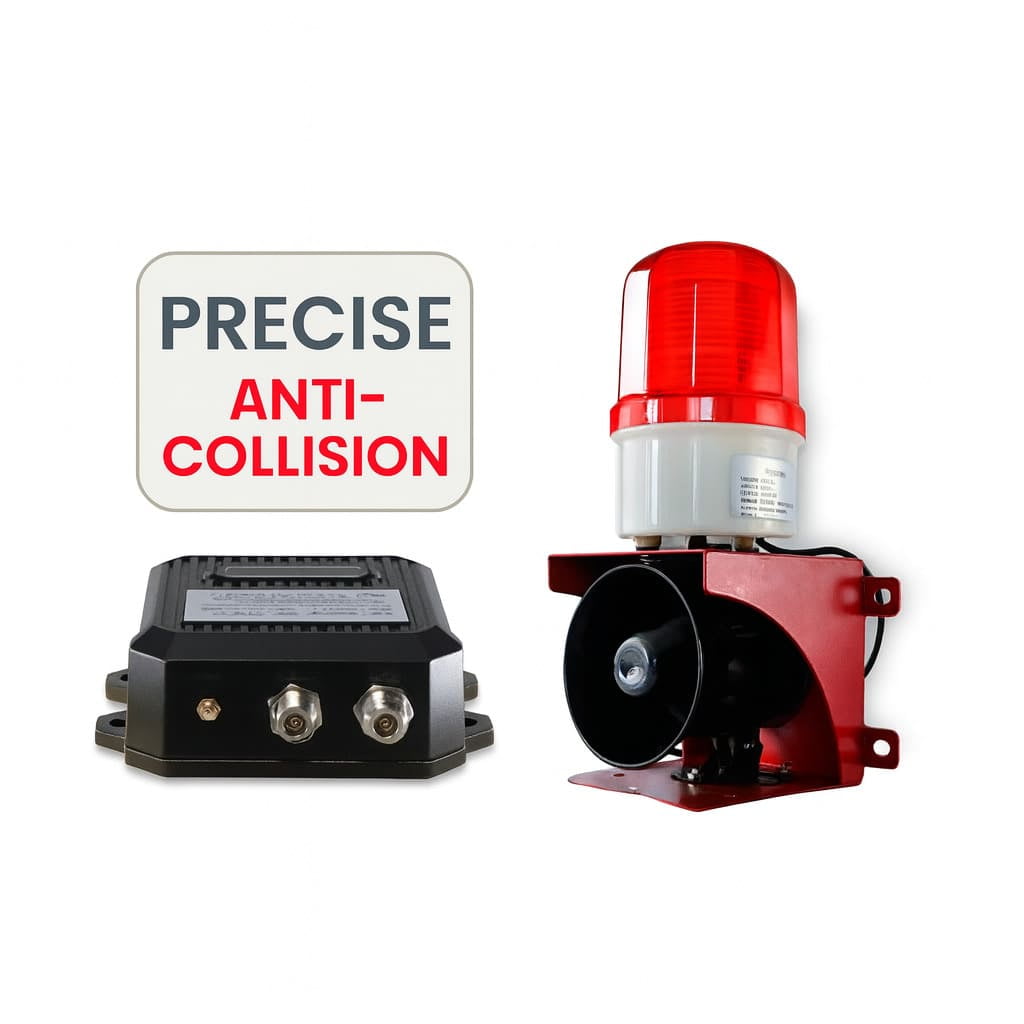
Main product image of the FZ anti-collision radar and audio-visual alarm with ‘Precise Anti-Collision’ label.
Collision AvoidanceConstruction

FZ Industrial Collision Avoidance Radar

The FZ Collision Avoidance Radar is a high-precision industrial anti-collision device designed for vehicles, loaders, forklifts, cranes, and mining trucks. It supports a detection distance over 100 meters, 30 cm accuracy, dual-relay output, strong anti-interference capability, and IP67 protection for harsh industrial environments.
View Product
Procurement (Device & Data Layer)

Designing collision avoidance systems? Define safety logic before RFQ.<br />

Clarify collision scenarios, response time, alert paths, and fail-safe behavior<br /> before RFQ. This helps lock safety configuration early and avoid redesign later.<br />

Ready to Deploy RTLS?

Share your site layout and accuracy needs--we'll suggest a practical setup.

Contact Us