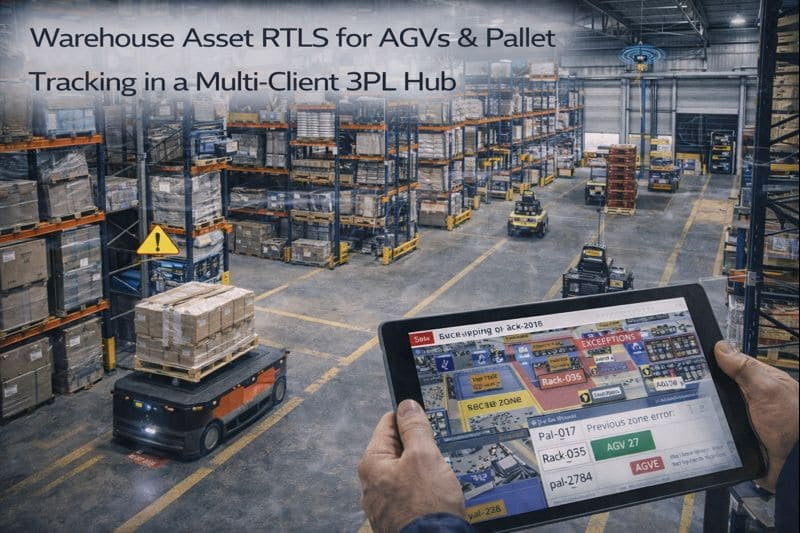
Warehouse Asset RTLS for AGVs & Pallet Tracking in a Multi-Client 3PL Hub
Centimeter-level visibility for pallets and autonomous fleets across aisles, docks, and staging zones.
Key Stats
KPIs (Before vs After)
| Metric | Before | After |
|---|---|---|
| Pallet search time (average) | 12 minutes | 3 minutes |
| Inventory location accuracy | 93 % | 98.5 % |
| AGV mission reassignments due to “unknown pallet state” | 28 per day | 8 per day |
| Manual exception tickets | 45 per week | 18 per week |
Overview
A Western European multi-client 3PL hub needed a single source of truth for pallet and vehicle location across high-bay aisles, staging zones, and dock doors. GridRTLS delivered a UWB-based asset RTLS that provides real-time pallet positions and AGV/forklift movements with zone-level intelligence—enabling faster picking, fewer exceptions, and more stable autonomous operations.
Customer Background
The site serves multiple retail and industrial customers with mixed SKU profiles, combining cross-dock throughput with high-bay storage. The warehouse runs autonomous mobile robots (AGVs) for repetitive pallet moves and relies on forklifts for put-away, replenishment, and exception handling. Seasonal peaks created frequent congestion at staging zones and increased the cost of “unknown inventory location,” especially when pallets were temporarily parked outside their expected slots.
Challenges
-
Dense racking and metal reflections: The operation required reliable positioning inside narrow aisles where multipath can degrade traditional signals.
-
AGV handoff integrity: Autonomous missions depended on accurate confirmation of “pallet present / picked / delivered” states at specific zones and time windows.
-
Dock-to-staging blind spots: Errors clustered around transitions—dock doors, staging buffers, and return lanes.
-
Operational scalability: The customer wanted a deployment approach that could expand by zone without disruptive rewiring and long downtime.
Solution
GridRTLS deployed a UWB asset RTLS designed for high-precision industrial tracking. UWB is well-suited for centimeter-level positioning and strong anti-interference characteristics in complex environments
The solution used:
-
UWB anchors/base stations to create stable coverage in aisles and critical transition areas.
-
Pallet tags attached to pallets/cages for real-time location updates.
-
Vehicle positioning terminals on AGVs/forklifts to coordinate fleet movement and validate zone entry/exit events.
-
Zone logic and alerts (geofences) to trigger exceptions when pallets dwell too long, move to the wrong zone, or when AGVs deviate from expected paths.
To reduce implementation disruption, the design followed a zone-by-zone rollout strategy using devices that can support fast installation and expansion. For example, wiring-free UWB beacon options enable flexible deployment with low maintenance overhead and long battery life characteristics.
Implementation
-
Site survey & zone mapping
Critical zones were defined first: receiving docks, staging buffers, high-value storage aisles, AGV charging and dispatch lanes. -
Anchor layout & calibration
Anchors were installed to prioritize “handoff certainty” at docks and staging, then extended into aisles for continuous tracking. Calibration included reference points at aisle ends and staging markers. -
Tag onboarding & ID binding
Pallet tags were bound to pallet IDs (or container IDs) and synchronized with the WMS master data. Vehicles were assigned IDs to map movement telemetry to fleet management systems. -
Integration with WMS & AGV orchestration
Events were exposed to upstream systems: “pallet arrived at staging,” “pallet picked,” “vehicle entered restricted zone,” and “dwell exceeded threshold.” -
Pilot → expand
A pilot ran in two aisles and one dock cluster, then expanded to the full warehouse once KPIs met target ranges.
Results
Within the first operating cycle after go-live, the 3PL significantly reduced time spent searching for pallets and stabilized AGV mission success rates by improving handoff certainty at key zones. The site achieved:
-
Faster location confirmation in dense aisles and staging zones
-
Higher inventory location accuracy during cycle counts
-
Fewer WMS exceptions and fewer AGV reassignments caused by “unknown pallet state”
-
A clearer operational picture for supervisors during peak waves
Confidentiality note: Customer identity is withheld. Metrics reflect measured improvements during initial operations and may vary by layout, density, and process discipline.
Quote
“Once pallet location became reliable at the dock and staging zones, exceptions dropped immediately. The RTLS data helped our team and our AGVs agree on what actually happened—so throughput stayed predictable during peak shifts.”
Related Solutions
Related Products
Want a similar deployment?
Share your site type, tag count, coverage area, and safety requirements. We’ll recommend a UWB / GNSS design and a rollout plan.