Gantry Crane & Yard Stacker RTK Precision Case Study: Container Yard Throughput and Position Accuracy
Centimeter-level RTK positioning for gantry cranes and yard stackers—reducing rehandles and improving container placement accuracy.
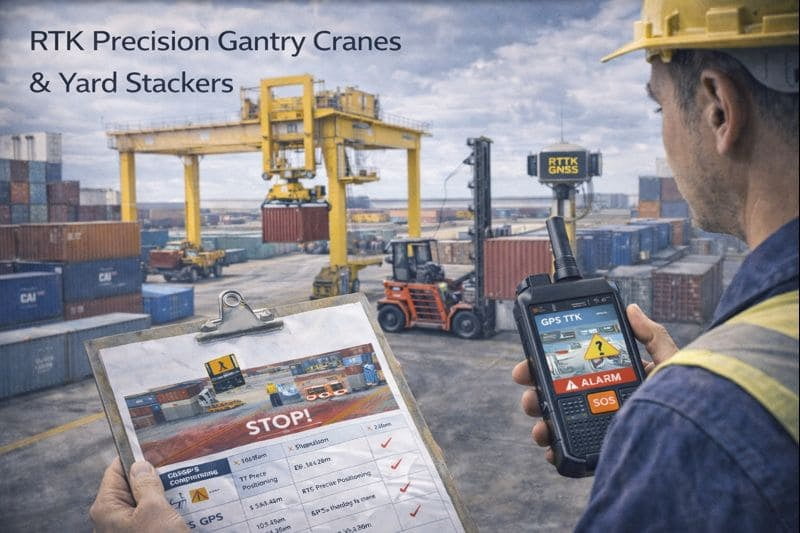
Key Stats
KPIs (Before vs After)
| Metric | Before | After |
|---|---|---|
| Container rehandle rate | 11 % | 4 % |
| Average crane cycle time (pick-move-place) | 3.8 minutes | 3.1 minutes |
| Placement accuracy at target slot | 82 % | 97 % |
| Rail-yard loading delays caused by misalignment | 9 events / week | 2 events / week |
Overview
Container yards demand precision at scale. As crane spans grow wider and throughput increases, small positioning errors accumulate into rehandles, delays, and congestion. GridRTLS deployed an RTK-based precision positioning system for gantry cranes and yard stackers, enabling centimeter-level alignment and data-driven yard operations.
Customer Background
The customer operates an inland container yard connected to the national rail network. The yard handles a mix of import/export containers and serves as a consolidation point for regional distribution.
Operations include:
-
Rail-served container blocks
-
Rubber-tired gantry cranes (RTG)
-
Yard stackers and reach stackers
-
High daily peak fluctuations driven by train schedules
With increasing volume, manual alignment and visual guidance were no longer sufficient to maintain efficiency.
Challenges
-
Visual alignment limits
Crane operators depended on experience and markings, which varied by lighting, weather, and operator skill. -
High rehandle cost
Misplaced containers often required secondary moves, consuming time and fuel. -
Rail-yard synchronization pressure
Missed alignment during rail loading caused cascading delays. -
Lack of objective precision data
Management could not quantify positioning accuracy or identify systemic inefficiencies.
Solution
GridRTLS implemented an RTK-based crane and vehicle positioning architecture:
1) RTK reference infrastructure
A GNSS Differential Reference Station was installed at a surveyed location to provide real-time correction data across the yard.
2) Crane & stacker positioning terminals
Each gantry crane and yard stacker was equipped with an RTK positioning terminal, delivering:
-
Centimeter-level position accuracy
-
Continuous heading and movement data
-
Real-time coordinates aligned with yard slot maps
3) Yard coordinate model
The yard was modeled as a digital grid with defined:
-
Container slots
-
Rail alignment points
-
Buffer and exclusion zones
RTK positions were mapped directly to this coordinate system, eliminating manual translation.
4) Operations & analytics layer
Supervisors gained:
-
Live crane and vehicle positions
-
Historical movement replay
-
Accuracy and efficiency metrics by block, shift, and operator
Implementation
Phase 1 — Survey and coordinate definition
The yard was surveyed to establish a common coordinate reference aligned with rail tracks and container rows.
Phase 2 — RTK deployment
RTK terminals were mounted on cranes and stackers with vibration-resistant fixtures and redundant power.
Phase 3 — Integration and calibration
Correction data was distributed via industrial gateways over the yard network. Calibration focused on validating slot-level accuracy rather than abstract coordinates.
Phase 4 — Operator training and tuning
Operators were trained to use RTK guidance for final placement, while supervisors tuned thresholds for acceptable deviation.
Results
After deployment:
-
Rehandles dropped by more than 60%, directly improving throughput.
-
Placement accuracy approached 97%, reducing corrective moves.
-
Rail-yard coordination improved, with fewer missed loading windows.
-
Management gained measurable KPIs, enabling data-driven optimization instead of anecdotal adjustments.
The RTK system shifted crane operations from experience-based execution to precision-guided workflows.
Quote
“RTK positioning changed how we think about crane accuracy. We stopped arguing about whether a placement was ‘good enough’ and started measuring it. That alone reduced rehandles and stabilized peak operations.”<br />
— Yard Operations Manager (Anonymized)
Related Solutions
Related Products
Want a similar deployment?
Share your site type, tag count, coverage area, and safety requirements. We’ll recommend a UWB / GNSS design and a rollout plan.