Airport Apron & Ground Operations RTLS Case Study: Personnel Safety, Vehicle Control, and Response Time
Real-time visibility across apron zones—reducing near-miss risk and improving ground coordination during peak flight operations.
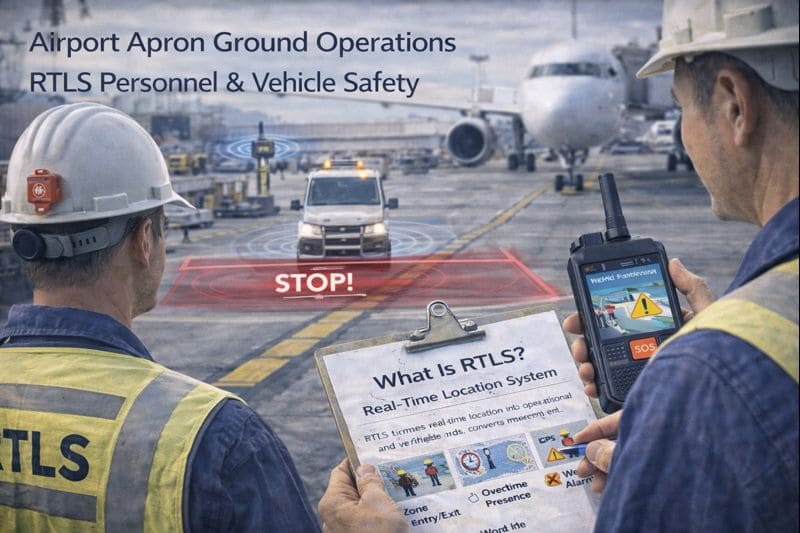
Key Stats
KPIs (Before vs After)
| Metric | Before | After |
|---|---|---|
| Reported apron near-miss incidents | 14 incidents / month | 5 incidents / month |
| Average time to locate personnel during apron incidents | 12 minutes | 4 minutes |
| Unauthorized entry into restricted apron zones | 7 incidents / month | 2 incidents / month |
| Average aircraft turnaround delay linked to ground coordination | 9 minutes | 3 minutes |
Overview
Airport aprons are among the most complex and safety-critical working environments. Aircraft, ground vehicles, and personnel operate in close proximity under time pressure, noise, and limited visibility. GridRTLS deployed an airport apron RTLS to provide real-time visibility of personnel and vehicles, enforce restricted zones, and support faster, data-driven response during incidents.
Customer Background
The customer operates a regional international airport serving both passenger and cargo flights. Daily operations include hundreds of aircraft movements and thousands of ground staff interactions across the apron.
Ground operations involve:
-
Aircraft marshaling and docking
-
Baggage loading and unloading
-
Catering and fueling
-
Line maintenance and inspections
Peak periods often compress multiple operations into short time windows, increasing the risk of miscoordination.
Challenges
-
High-density mixed traffic
Personnel and vehicles share limited apron space around aircraft. -
Restricted and dynamic zones
Safety zones change depending on aircraft type, engine status, and operation phase. -
Limited situational awareness
Supervisors could not see real-time positions of staff and vehicles across the apron. -
Near-miss investigation gaps
Incidents were reported after the fact, with limited objective data. -
Emergency response uncertainty
Locating specific staff during incidents took too long.
Solution
GridRTLS implemented an UWB RTLS architecture optimized for airport apron operations:
1) Apron-wide UWB positioning
UWB anchors were deployed around gates, apron lanes, and high-risk intersections to provide precise positioning of personnel and vehicles in GPS-challenged areas near aircraft fuselages.
2) Wearable personnel tracking
Ground staff wore AQM hybrid positioning safety helmets, enabling:
-
Continuous location tracking
-
SOS alerts during incidents
-
Automatic logging of zone entry and exit
3) Vehicle positioning and control
Ground vehicles were equipped with vehicle-mounted positioning terminals, allowing:
-
Real-time tracking
-
Speed-zone enforcement near aircraft
-
Proximity alerts between vehicles and personnel
4) Safety zoning and alerts
Virtual zones were configured for:
-
Aircraft safety envelopes
-
Engine run-up areas
-
Restricted maintenance zones
Alerts were triggered when personnel or vehicles entered zones without authorization.
Implementation
Phase 1 — Apron mapping and zone definition
The apron was digitally mapped to define gates, taxiway intersections, and aircraft safety envelopes.
Phase 2 — Infrastructure deployment
UWB anchors were installed with weather-resistant mounts designed to withstand jet blast, vibration, and temperature variation.
Phase 3 — Device rollout
Personnel and vehicles were equipped in phases to avoid operational disruption. Training focused on interpreting alerts and SOS workflows.
Phase 4 — Operational tuning
Alert thresholds and zone boundaries were refined based on aircraft type, operation phase, and feedback from ground crews.
Results
After deployment:
-
Near-miss incidents were reduced by more than 60%, improving apron safety.
-
Response time during incidents dropped significantly, with supervisors able to locate staff within minutes.
-
Restricted zone compliance improved, reducing unauthorized access events.
-
Aircraft turnaround became more predictable, as fewer safety-related disruptions occurred.
The RTLS provided a shared operational picture for safety, operations, and airport management teams.
Quote
“On the apron, seconds matter. Knowing exactly where our people and vehicles are has changed how we manage safety. It’s no longer reactive—it’s visible and measurable.”<br />
— Airside Operations Manager (Anonymized)
Related Solutions
Related Products
Want a similar deployment?
Share your site type, tag count, coverage area, and safety requirements. We’ll recommend a UWB / GNSS design and a rollout plan.